LED lighting before year end: KIA, EIA and planning for Dutch businesses
Many companies replace their lighting in the last months of the year. What the Dutch small-scale investment allowance (KIA) and energy investment allowance (EIA) can mean, what to watch out for and how to have the luminaires on site in time.
Why businesses invest in the autumn
At the end of the year many business owners review the numbers with their accountant. If a replacement of hall or site lighting is planned, it can matter for tax purposes whether the investment falls in this year or the next. At the same time it is dark on site and in the hall now, so the need is greatest.
This article covers the two Dutch schemes that come up most often for lighting: the kleinschaligheidsinvesteringsaftrek (KIA) and the energie-investeringsaftrek (EIA). We are not tax advisers. Amounts, percentages and conditions change every year, so always have your situation confirmed by your accountant and check the current rules with the Belastingdienst and RVO.
Small-scale investment allowance (KIA)
The KIA is an extra deduction for businesses that invest in business assets within a calendar year. Whether you qualify and how much you can deduct depends on your total investment in that year. The lower limit, upper limit and percentages are set each year by the Belastingdienst. A minimum amount applies per asset.
Luminaires, floodlights, lighting columns and their installation are business assets, so a lighting replacement can count towards the KIA alongside other investments this year.
Timing matters: an investment counts in the year you enter into the commitment, usually the order date. If it is not yet paid and not yet in use at year end, only the part you have paid counts. Your accountant knows how this works out for you.
Energy investment allowance (EIA)
The EIA is meant for energy-saving business assets. Only items on the RVO Energielijst, with the right code and conditions, qualify. Ordinary LED lighting is not automatically on that list; check the current Energielijst first.
Important: you apply for the EIA with RVO within three months of placing the order. Missing that deadline means no allowance. KIA and EIA can apply to the same investment.
Planning: what needs to arrive when
Luminaires and floodlights from stock are delivered within 5 working days. Steel columns take 3 to 5 weeks and aluminium columns 4 to 6 weeks, so order site projects with columns in November.
- Halls and warehouses: UFO high bay 100 W, 18,000 lm at 78.99 euro or the 1-10V dimmable 100 W UFO at 47.55 euro.
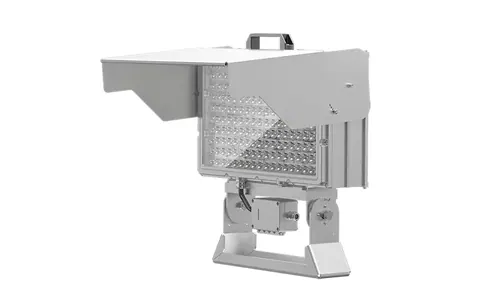
- Facades and loading docks: FLUX floodlight 100 W, 16,000 lm at 81.15 euro.
- Car parks and access roads: VIA street light 20 to 50 W at 105 euro on a 6 metre steel column at 299 euro.
All prices excl. VAT for the first tier. From 100 luminaires or 20 columns we quote a project price. See also site lighting for the dark months.
Frequently asked questions
Does LED lighting count for the KIA?
Luminaires, floodlights and columns are business assets and can count when your total investments that year fall within the scheme limits. Check the current amounts with the Belastingdienst and your accountant.
Does LED lighting qualify for the EIA?
Only if the investment falls under a code on the current RVO Energielijst and meets its conditions. Apply within three months of the order.
Send us your floor plan or a Google Maps image of the site. You get a lighting calculation with quantities and prices to discuss with your accountant, or order directly from ATRIA, FLUX and VIA.
Read also
 Knowledge
Site lighting for the dark months: checklist for business sites and car parks
Once the clocks go back it is dark by half past four, and the first and last hour of the working day happen in the dark. How to check your outdoor lighting now, fill the gaps and have the luminaires on site before the shortest days.
25 October 2026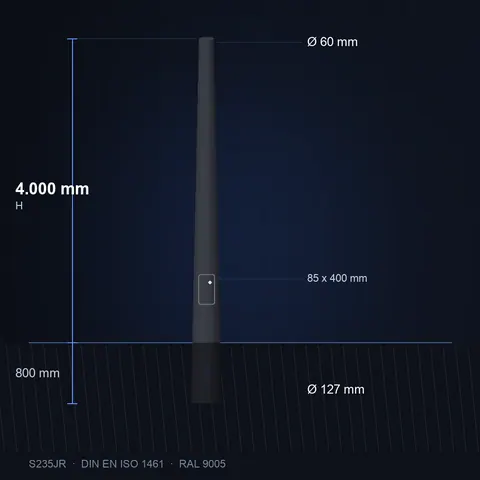 News
New: steel and aluminium lighting columns to the Dutch standard
Lichtplein now supplies conical steel lighting columns of 4 and 6 metres at a sharp price on request, plus aluminium columns of 3, 4 and 6 metres. With full dimensions on the product page, matching our street and post-top luminaires, delivered by truck.
8 October 2026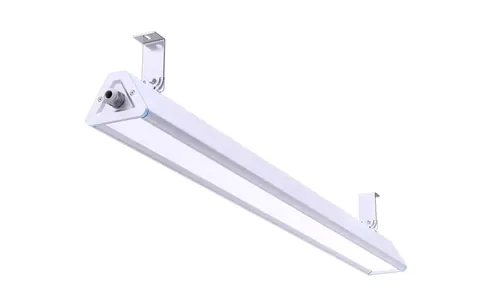 Worked examples
Worked example: a 4,000 m² warehouse from fluorescent to LED high bay
A fictional hall of 80 by 50 metres, 10 metres high, 200 lux required. Step by step we work out how many 150 W UFO high bays are needed, what that saves per year in kWh compared with fluorescent, and what sensors add on top.
8 October 2026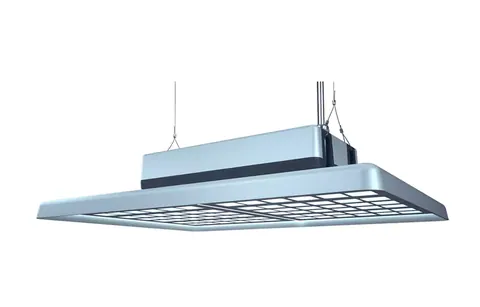 Knowledge
UFO or linear high bay: which one for your warehouse or hall
A high bay comes as a round UFO, as a linear luminaire above the racking aisle and as a flat panel with UGR<21. Which one you choose depends on mounting height, racking and the work done in the hall. This article gives the selection rules and a worked example for the number of luminaires.
8 October 2026