Site lighting for the dark months: checklist for business sites and car parks
Once the clocks go back it is dark by half past four, and the first and last hour of the working day happen in the dark. How to check your outdoor lighting now, fill the gaps and have the luminaires on site before the shortest days.
Why now: winter time moves your peak hours into the dark
On the last Sunday of October the clocks go back an hour. From then on sunset in the Netherlands falls before half past five, and around half past four in December. The morning shift arrives in the dark, lorries load in the dark and visitors look for their car on a poorly lit site after five.
Floodlights and street lights from our stock are delivered within 5 working days. Steel columns take 3 to 5 weeks, aluminium columns 4 to 6 weeks. If you want a new lighting point ready before the shortest days, order the column in the first half of November. Investing in new lighting before year end? See LED lighting before year end: KIA, EIA and planning.
Checklist: walk the site once after sunset
- Failures: does every luminaire work? One that is off or flickering often has a driver at the end of its life or moisture inside. See condensation in outdoor luminaires.
- Dark zones: walkways, stairs, loading bays, the barrier and the corner by the waste containers.
- Uniformity: bright spots under the luminaires with dark strips in between mean the points are too far apart or the beam is too narrow.
- Glare: if a driver or neighbour looks straight into a floodlight, the tilt angle is wrong.
- Switching: a dirty photocell or a time switch still on summer time leaves the site dark for the first hour.
How much light does a site need?
Guide values for outdoor workplaces are in EN 12464-2. For a car park with light traffic count on about 5 lux, normal traffic 10 lux and heavy traffic 20 lux. Loading areas and yards with forklift traffic need more. A lighting calculation shows what you actually achieve.
Quick estimate: multiply the area by the target lux and add a good half for light falling outside the area and for ageing. For 1,000 m² at 10 lux that is roughly 15,000 to 20,000 lumen installed. Two or three smaller lighting points give a far more even result than one large one.
Facades and corners: floodlights with sensor
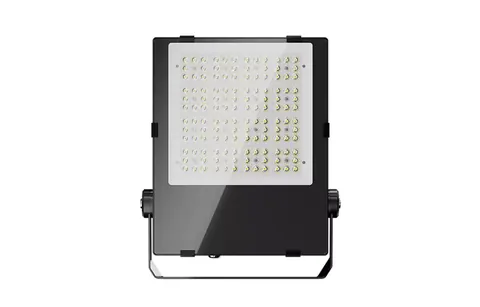
For facades, doors and corners a compact floodlight is often enough. The FLUX compact 50 W gives 7,500 lm at 4000K, is IP66 and costs 46.35 euro each excl. VAT from 5 units. Add the plug-in microwave sensor with daylight sensor (16.35 euro) so it only switches on when it is dark and someone is there.
For larger areas choose the FLUX 100 W with 16,000 lm (81.15 euro) or the 150 W with 25,500 lm (97.25 euro), both IP66 and IK10 with a wide 120x150 degree optic and 5 year warranty.
Car park and access road: street light on a column
The VIA street light 20 to 50 W with 7,500 lm (105 euro) and the 30 to 80 W with 12,000 lm (125 euro) have adjustable wattage, IP66 and 10 kV surge protection and fit a 60 mm spigot. In the outlet the VIA 60 W with built-in daylight sensor is 65.95 euro each (box of 3).
Underneath goes the 6 metre hot-dip galvanised steel column for 299 euro, or 4 metres for 295 euro, with a mounting rail for the connection box and CE marking to EN 40.
On at dusk, off when possible
In winter site lighting easily burns 14 to 16 hours a day. Use a daylight sensor instead of a time switch, motion sensors on walkways and night-time dimming via 1-10V or DALI drivers on street lights.
Frequently asked questions
How quickly can I get new floodlights?
Floodlights and street lights from stock are delivered within 5 working days. Steel columns take 3 to 5 weeks, aluminium columns 4 to 6 weeks.
Can I order directly?
Yes. Items with a price can be checked out directly with the Order now button. For larger quantities or a complete site, request a quote or lighting calculation.
Send us a Google Maps image of the site and the required light level. You will receive a lighting calculation with quantities, positions and prices, or order directly from the FLUX series and VIA series.
Read also
 Knowledge
LED lighting before year end: KIA, EIA and planning for Dutch businesses
Many companies replace their lighting in the last months of the year. What the Dutch small-scale investment allowance (KIA) and energy investment allowance (EIA) can mean, what to watch out for and how to have the luminaires on site in time.
28 October 2026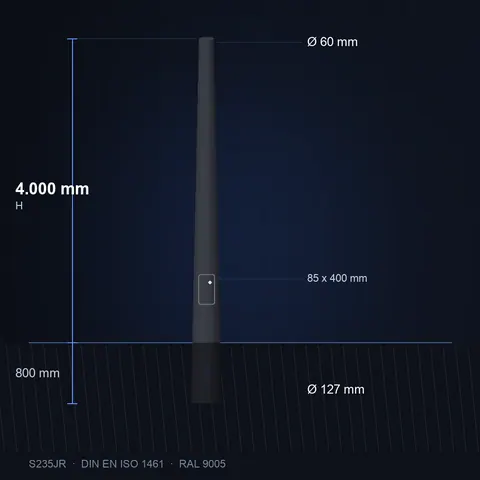 News
New: steel and aluminium lighting columns to the Dutch standard
Lichtplein now supplies conical steel lighting columns of 4 and 6 metres at a sharp price on request, plus aluminium columns of 3, 4 and 6 metres. With full dimensions on the product page, matching our street and post-top luminaires, delivered by truck.
8 October 2026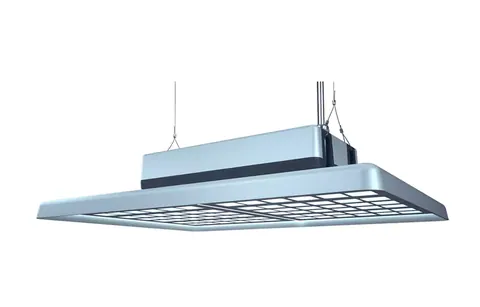 Knowledge
UFO or linear high bay: which one for your warehouse or hall
A high bay comes as a round UFO, as a linear luminaire above the racking aisle and as a flat panel with UGR<21. Which one you choose depends on mounting height, racking and the work done in the hall. This article gives the selection rules and a worked example for the number of luminaires.
8 October 2026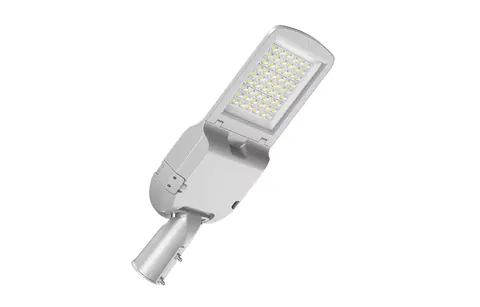 Knowledge
3000K, 4000K or 5000K: choosing colour temperature by application
Kelvin decides whether light looks warm, neutral or cool, and with it whether a street feels comfortable and a warehouse works well. We set out the right colour temperature for each application.
7 October 2026