LED lifetime explained: L70, L80 and L90
An LED rarely fails outright, it slowly loses output. L70, L80 and L90 state how much light is left after a given number of hours. Here is how to read those values, how manufacturers arrive at 50,000 or 100,000 hours and how to plan replacement.
Lumen depreciation: the LED does not go out, it fades
An incandescent or discharge lamp simply fails one day. An LED rarely does. The chip gradually loses luminous flux as the phosphor layer ages and the optic yellows slightly. That process is called lumen depreciation. It happens so slowly that nobody notices, until a measurement shows the hall is down to 65 per cent of its original light level.
That is why LED lifetime is not expressed as 'fails after' but as 'still delivers so many per cent after'. The L-value captures this. L70 means the luminaire still delivers 70 per cent of its original luminous flux after the stated number of hours, L80 still 80 per cent and L90 still 90 per cent. A rating of L80 at 50,000 hours therefore says: after 50,000 operating hours the output has dropped from, say, 15,000 to 12,000 lumens.
A B-value often follows. B10 means that at most 10 per cent of the luminaires fall below the threshold, B50 that half of them do. L80B10 at 50,000 hours is therefore a stricter rating than L80B50 at the same hours. If no B-value is given, assume B50: the median.
How manufacturers arrive at 50,000 or 100,000 hours
Nobody tests a luminaire for 100,000 hours, that is more than eleven years of continuous operation. The figures are an extrapolation, and two standards govern it. LM-80 prescribes how the LED chips (not the luminaire) are measured: at least 6,000 hours, at several solder point temperatures, usually 55 and 85 degrees plus a third of the maker's choice. Chip manufacturers such as Lumileds, CREE and Bridgelux publish those reports.
TM-21 then determines how far you may extend that measured data: at most six times the test duration, provided the sample is large enough. A 6,000 hour test justifies a rating up to 36,000 hours, a 10,000 hour test up to 60,000 hours. Anything beyond that is a calculated value in TM-21 terms, not a reported value. A claim of 100,000 hours L70 is therefore only solid if the chip has been tested for well over 16,000 hours (100,000 divided by six). And even then the value applies to the chip, not automatically to the complete luminaire.
So always ask three things of a datasheet: the L- and B-value, the number of hours and the temperature (Tc or Ts) at which it applies. A rating without a temperature cannot be compared.
Temperature matters most
Of all factors, the junction temperature Tj of the LED chip weighs heaviest. The hotter the chip, the faster the depreciation. A chip that reaches L80 at 60,000 hours at 55 degrees may get there in half those hours at 85 degrees. That is why LM-80 curves differ so widely per temperature.
Three things set that temperature: the ambient temperature under the roof (easily 40 degrees in a steel hall in summer), the heatsink of the luminaire and the current through the chips. A high efficiency luminaire, such as the ATRIA high bays at up to 180 lm/W, converts less power into heat for the same luminous flux and so runs cooler. Dimming helps too: a luminaire running at 70 per cent runs noticeably cooler and lasts longer.
So check the stated ambient temperature (Ta). If the maximum is 45 degrees and the luminaire hangs above an oven or under an unventilated dark roof, the lifetime claim no longer applies.
The driver usually fails before the LED
Open a failed luminaire and you will almost always find a dead driver and healthy LEDs. The driver contains electrolytic capacitors, and those dry out with heat: as a rule of thumb their lifetime halves with every 10 degree rise in temperature. Driver manufacturers such as Meanwell and Tridonic therefore state a lifetime at a case temperature Tc, often shorter than the stated lifetime of the LED module. And unlike the LED, a driver fails abruptly: the luminaire goes dark in one go.
For you this means: do not only look at the L70 of the LED on the datasheet, but also at the lifetime and Tc of the driver. In street lighting it is practical if the driver can be replaced separately. The VIA street luminaires come in versions with a separate driver and with DALI-2 or D4i, fitting a 60 mm column top. So after ten years you swap the driver during a fault and leave the luminaire on the column.
What it means for your lighting design
The standards for workplaces (EN 12464-1) and road lighting (EN 13201) prescribe a maintained illuminance: the level that must still be achieved at the end of the maintenance period. A warehouse that needs 200 lux must therefore receive more on day one. That is what the maintenance factor (MF) is for: the expected lumen depreciation multiplied by the soiling of luminaire and room.
If you choose a 50,000 hour period and a luminaire rated L80 at those hours, you use 0.8 for depreciation, multiplied by roughly 0.9 for soiling in a clean room, giving an MF of 0.72. For 200 lux maintained you then design for around 280 lux initial. A luminaire with L90 at the same hours immediately saves well over ten per cent in the number of luminaires or in wattage. That is how a better L-value pays for itself in the lighting calculation.
Replacement planning: from hours to years
Convert the hours to your situation. A single shift warehouse runs roughly 2,500 to 3,000 hours a year, two shifts around 5,000 hours, a production hall in continuous operation 8,760 hours. Street lighting in the Netherlands runs about 4,000 hours a year. A luminaire rated L80 at 50,000 hours is therefore down to 80 per cent after almost six years in a continuous hall, but only after more than twelve years on a lighting column.
Plan a group replacement on that basis rather than replacing one at a time: one access platform, one new lighting calculation and a uniform appearance. Record the measured lux values at handover, then after five years you can measure objectively whether the depreciation matches. Lichtplein sells to businesses only, gives up to 5 years warranty on luminaires and offers project pricing from 100 units.
Frequently asked questions
Is L70 or L80 better?
L80 is stricter: the luminaire still delivers 80 instead of 70 per cent of its original light after the same hours. Always compare at equal hours and equal temperature, otherwise the letter means nothing.
What does L80B10 at 50,000 hours mean?
After 50,000 operating hours at least 90 per cent of the luminaires still deliver 80 per cent of their original luminous flux. Without a B-value, B50 usually applies: half the luminaires.
Is 100,000 hours realistic?
Only if the chip has been tested for well over 16,000 hours to LM-80 and the rating states the temperature. It is often a calculated value for the LED chip, while the driver fails earlier.
Does dimming extend lifetime?
Yes. Less current means a cooler chip and driver, and therefore slower depreciation. A luminaire running at 70 per cent reaches its L-value considerably later.
Is lumen depreciation covered by warranty?
Warranty generally covers failure and defects within the period, not normal gradual depreciation. Lichtplein gives up to 5 years warranty on luminaires; for an unusual application, ask for the conditions in advance.
Want to know which L-value and maintenance factor suit your project? Request a lighting calculation or browse the ATRIA high bays and VIA street luminaires.
Read also
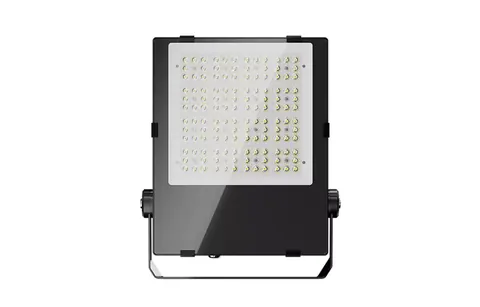 Knowledge
LED lighting before year end: KIA, EIA and planning for Dutch businesses
Many companies replace their lighting in the last months of the year. What the Dutch small-scale investment allowance (KIA) and energy investment allowance (EIA) can mean, what to watch out for and how to have the luminaires on site in time.
28 October 2026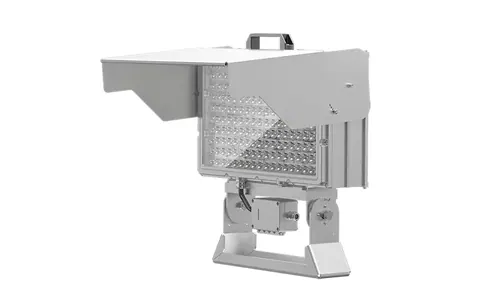 Knowledge
Site lighting for the dark months: checklist for business sites and car parks
Once the clocks go back it is dark by half past four, and the first and last hour of the working day happen in the dark. How to check your outdoor lighting now, fill the gaps and have the luminaires on site before the shortest days.
25 October 2026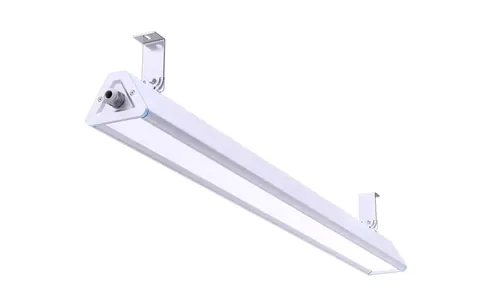 Worked examples
Worked example: a 4,000 m² warehouse from fluorescent to LED high bay
A fictional hall of 80 by 50 metres, 10 metres high, 200 lux required. Step by step we work out how many 150 W UFO high bays are needed, what that saves per year in kWh compared with fluorescent, and what sensors add on top.
8 October 2026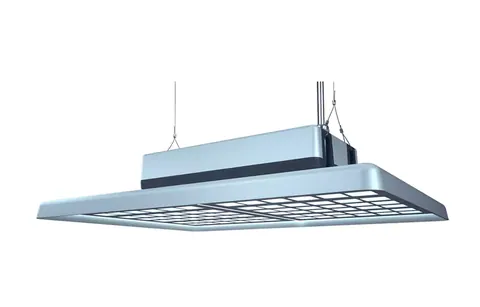 Knowledge
UFO or linear high bay: which one for your warehouse or hall
A high bay comes as a round UFO, as a linear luminaire above the racking aisle and as a flat panel with UGR<21. Which one you choose depends on mounting height, racking and the work done in the hall. This article gives the selection rules and a worked example for the number of luminaires.
8 October 2026