Saving energy with sensors and daylight control in halls
In most halls the lighting runs at full power while nobody is in the aisle. With plug-in sensors, daylight control and sensible zoning you can save a large share of that consumption; in the worked example in this article it comes to more than half.
Where the savings are
LED high bays are already efficient: the ATRIA range reaches up to 180 lm/W. Yet in a warehouse on day shift the lighting often burns 12 hours a day at full output, while an aisle is occupied for only a fraction of that time.
The workplace lighting standard gives indicative values of roughly 100 to 150 lux in storage aisles, 300 lux for order picking and packing and 500 lux for fine assembly work. You only need that level while someone is working. That gives you three levers:
- Presence: full light on movement, then back to a low standby level.
- Daylight: dim as soon as rooflights, dock doors or windows contribute enough.
- Zoning: switch per aisle or work zone, not the whole hall.
PIR or microwave: which plug-in sensor fits where
A plug-in sensor clicks into the sensor socket of a sensor-ready high bay; the UFO high bays in the ATRIA range are available this way. Two technologies:
- PIR (passive infrared) sees moving heat within the field of view of its lens. Reliable up to about 6 to 8 metres mounting height, needs a clear line of sight.
- Microwave (HF) measures the change in the reflection of a transmitted signal. Works up to 12 to 15 metres and looks through thin plastic. Set too wide, it also picks up the forklift in the next aisle.
Rule of thumb: PIR up to 8 metres, microwave above that. On both you set the detection range (25 to 100%), the hold time at full light (2 to 5 minutes in an aisle), the standby level (10 to 30%) and how long standby lasts before the luminaire switches off. In dusty storage choose IP65, for the sensor too.
Zhaga sensors and the group function
One sensor per luminaire works, but only the luminaire above you comes on: in a long aisle you keep driving towards a dark stretch. Sensors with a group function talk to each other wirelessly. When one sensor detects movement, the whole aisle goes to full light while the neighbouring aisles stay in standby.
Zhaga is the standardised sensor socket on the luminaire (Book 18 for outdoor, Book 20 for indoor). With a D4i driver the sensor draws its power and DALI communication from the driver itself, without extra wiring, and can later be replaced without touching the luminaire. If you want the group function, mention it in your enquiry; we then check which combination of luminaire, driver and sensor is suitable for it.
Zoning above racking
The way you divide the hall into zones matters more than the sensor choice:
- One group per aisle. Linear high bays with a 30x90° optic, like the linear high bays in the ATRIA range, put the light in the aisle and not on top of the racking.
- Cross aisles and main routes as their own zone with a longer hold time: there is always traffic here.
- Picking and packing zones at a constant level during the shift, with daylight control only.
- Dock zone as a separate daylight zone: this is where most outside light comes in.
In narrow aisles set the detection range to 50 to 75% so a sensor does not see the next aisle over the racking. Keep 10 to 20% standby rather than off: cameras stay usable and nobody walks into a dark hall. Only in areas that stand empty for hours do you let the light switch off completely after 15 to 30 minutes.
Daylight control needs a dimmable driver
A daylight sensor measures the light at the luminaire and dims down until the set level is reached. That only works with a dimmable driver: 1-10V or 0-10V for a simple connection, DALI-2 if you want central control. In the ATRIA range the UFO high bays are available dimmable, the flat high bays with UGR<21 are 0-10V dimmable and the linear low bays have DALI. A non-dimmable luminaire with a sensor can only switch on and off; daylight then saves nothing.
The sensor measures reflected light at ceiling level, not the lux on the floor: calibrate the threshold with a lux meter at working height.
Payback: a worked example
Take a warehouse with 40 UFO high bays of 100 W and 3,000 burning hours a year (12 hours a day, 250 days). Without control each luminaire uses 300 kWh a year, 12,000 kWh in total. At an assumed rate of 0.25 euro per kWh that is 3,000 euro a year.
Suppose an aisle is at full light 35% of the time and at 20% standby for the other 65%. The average power then drops from 100 W to 48 W: a saving of 52%, or 6,240 kWh and 1,560 euro a year. Per light point that is 39 euro a year, so every 39 euro you spend per luminaire on sensor and installation is recovered within a year. Daylight control at docks and rooflights can add a further saving in those zones, depending on how much daylight comes in. The occupancy rate and the tariff are assumptions; your own figures determine the outcome.
Frequently asked questions
Does a PIR sensor still work at 12 metres?
Hardly. Above 8 metres the detection pattern of a PIR becomes too coarse. Choose a microwave sensor there and do not set the range to 100%.
Can I add sensors to high bays that are already installed?
Only if the luminaire has a sensor socket or a 1-10V dimmable driver. Otherwise replacing them with a sensor-ready UFO is usually cheaper than converting.
Does the light switch off completely or keep dimming?
You decide. In aisles 10 to 20% standby is common, switching off after 15 to 30 minutes without movement.
Do I need DALI for the group function?
Not necessarily. Some sensors with a group function communicate wirelessly among themselves and only need a dimmable driver; in other systems the grouping runs over DALI-2. For central monitoring DALI-2 or D4i is needed in any case.
Want to know what sensors would save in your hall? As a business customer, request a lighting calculation or browse the sensor-ready and dimmable high bays in the ATRIA range.
Read also
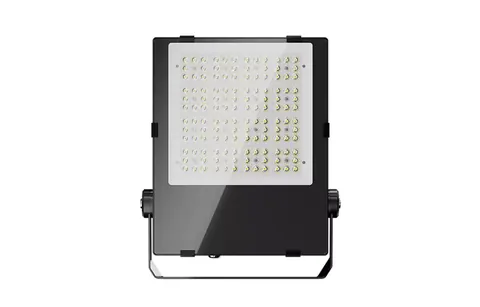 Knowledge
LED lighting before year end: KIA, EIA and planning for Dutch businesses
Many companies replace their lighting in the last months of the year. What the Dutch small-scale investment allowance (KIA) and energy investment allowance (EIA) can mean, what to watch out for and how to have the luminaires on site in time.
28 October 2026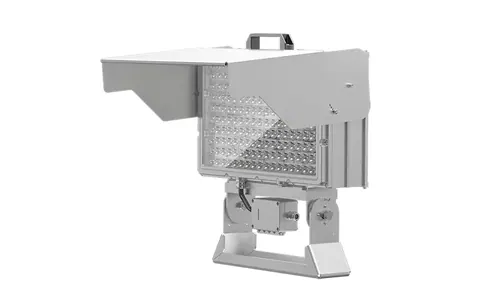 Knowledge
Site lighting for the dark months: checklist for business sites and car parks
Once the clocks go back it is dark by half past four, and the first and last hour of the working day happen in the dark. How to check your outdoor lighting now, fill the gaps and have the luminaires on site before the shortest days.
25 October 2026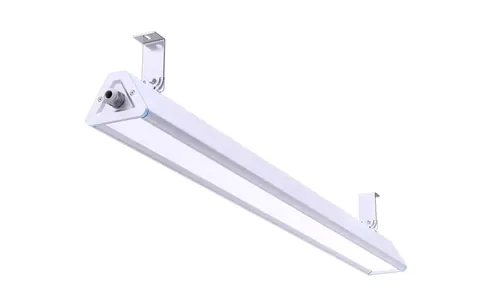 Worked examples
Worked example: a 4,000 m² warehouse from fluorescent to LED high bay
A fictional hall of 80 by 50 metres, 10 metres high, 200 lux required. Step by step we work out how many 150 W UFO high bays are needed, what that saves per year in kWh compared with fluorescent, and what sensors add on top.
8 October 2026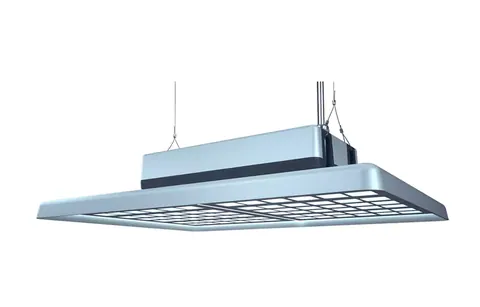 Knowledge
UFO or linear high bay: which one for your warehouse or hall
A high bay comes as a round UFO, as a linear luminaire above the racking aisle and as a flat panel with UGR<21. Which one you choose depends on mounting height, racking and the work done in the hall. This article gives the selection rules and a worked example for the number of luminaires.
8 October 2026