Flaneerkade, Den Helder: custom work with the municipal logo in the luminaire
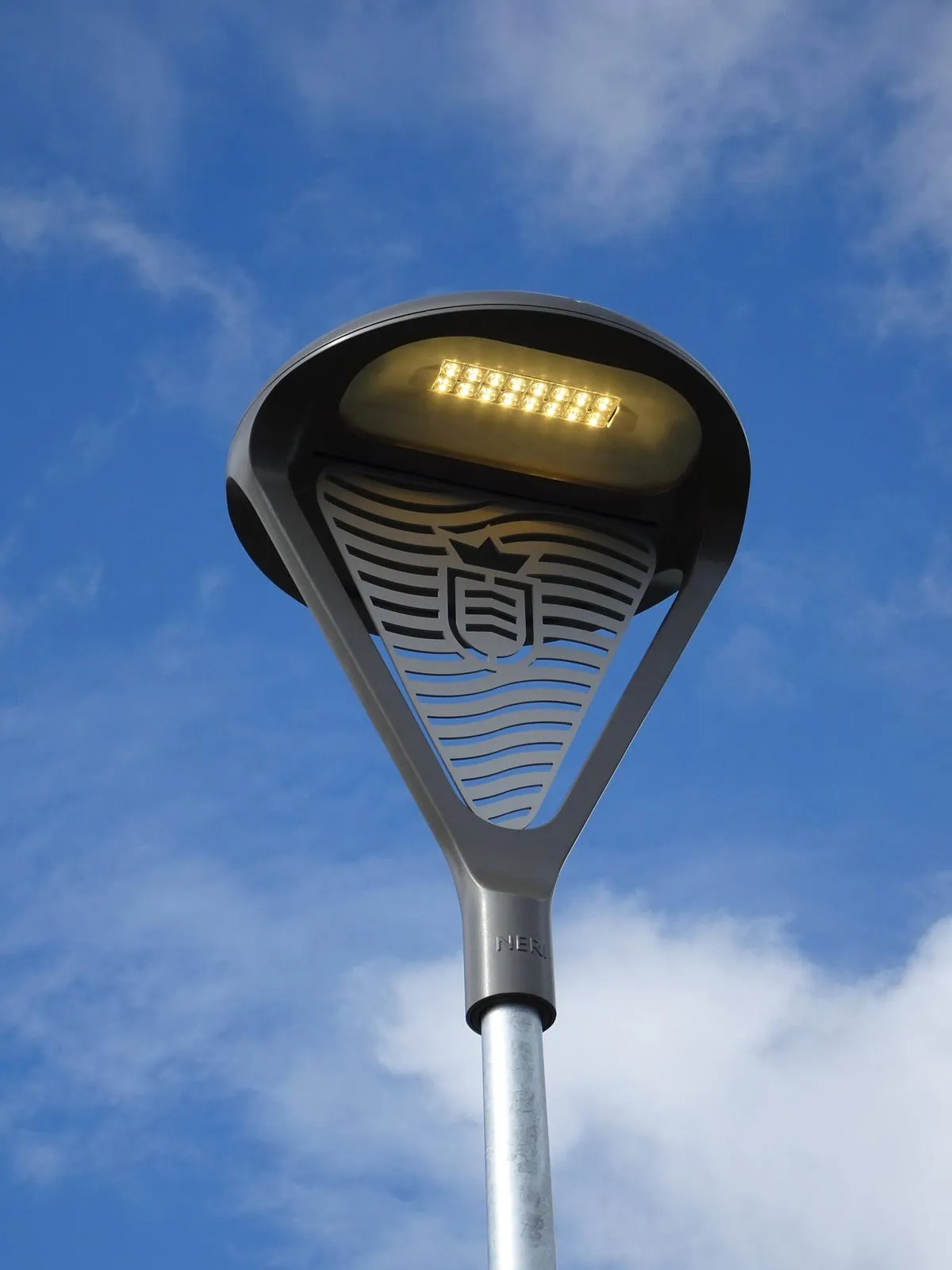
On the Flaneerkade in Den Helder stands a lighting column whose luminaire carries the municipal logo: a custom shield, designed by an urban planner. What such a detail demands of luminaire, column and coastal durability, and how you request comparable custom work from Lichtplein.
A waterfront promenade in the naval city
Den Helder, the naval city at the northern tip of North Holland, gained a waterfront promenade with the Flaneerkade. Instead of a standard catalogue column, it has a slender lighting column with a luminaire in which the municipal logo is incorporated as a shield: a lighting point that belongs to the place.
The shield was designed by an urban planner; the lighting supplier engineered it into a manufacturable, watertight component. A sketch on paper thus became a recognisable lighting point on the quay.
How a logo shield in a luminaire works
A custom shield is usually a laser-cut plate of aluminium or steel, mounted in or on the housing, outside the optic. The logo then appears as a silhouette against the lit surface or as an illuminated outline on the outside. Two things must remain intact:
- The light distribution. The shield must not cover the lens, otherwise the lighting calculation no longer holds.
- The sealing. Every additional seam is a risk to the IP rating. Outdoors on the coast, IP66 is the minimum.
What the coastal location demands
Den Helder lies by the sea, in the most severe wind zone of the Netherlands and in a salt-laden atmosphere. That places demands on column, luminaire and fixings:
- Column to EN 40, calculated for the local wind load.
- Hot-dip galvanised steel with powder coating, or aluminium, which does not rust. On a salty coast you allow for a high corrosivity category; ask for a coating system matched to it.
- Stainless fixings, including for the shield itself.
- A driver with 10 kV surge protection: long cable runs along open water pick up spikes.
The light level on a promenade
A promenade with many pedestrians in the evening falls within the pedestrian classes (P classes) of the standard for public lighting. As a guide value, in practice you aim for 7.5 to 10 lux average, with good uniformity and without glare, so that faces remain recognisable at a distance. Warm white of 2700 to 3000 K suits a waterfront amenity area and contains less blue light than 4000 K, which is often a requirement near water and greenery because of the effect on nocturnal wildlife. A lighting calculation on the actual column spacing gives certainty about the light level.
Comparable custom work through Lichtplein
For comparable projects Lichtplein supplies the standard combination: street luminaires from VIA (IP66, 10 kV surge protection, tiltable on a 60 mm spigot, 25 to 100 W) or post-top luminaires from POLARIS (IP66, adjustable from 2200 to 4000 K, spigot 60 to 80 mm), on a conical steel column from TURRIS of 4 or 6 metres, hot-dip galvanised or in RAL 9005, or an aluminium column from CIVIS. We supply luminaires from European stock within 5 working days; steel columns have a lead time of 3 to 5 weeks, aluminium columns 4 to 6 weeks.
If your project falls outside the standard, such as a project colour, a different light point height or a shield with a logo, state this in your quote request or email your drawing to info@lichtplein.nl. We assess what is feasible and come back with a proposal. Lichtplein supplies businesses only; the installation is carried out by your own fitting crew.
Frequently asked questions
Can any luminaire be given a logo?
No. The shield must sit outside the optic and leave the housing sealed. On a flat street luminaire the logo can go on the side or underside of the housing, on a post-top luminaire in the canopy or the column head. Always ask for a drawing before you order.
How many columns are needed for custom work?
Project prices for columns apply from 20 units. A custom shield is assessed per project: we tell you per request what is feasible and in which quantities.
Which column do you choose on the coast?
Aluminium does not rust and is a logical choice by the sea; hot-dip galvanised steel with powder coating also performs well, as long as the coating stays intact. Mind the wind zone: the coast falls in the most severe zone, so have the column calculated for it.
How much lux belongs on a promenade?
As a guide value, expect 7.5 to 10 lux average with many pedestrians, less on a quiet quay. A lighting calculation on the actual column spacing gives certainty.
Did Lichtplein supply or install this project?
No. Lichtplein is a wholesaler and does not install lighting itself: installers and municipalities carry out the work. We share this project as an example of what custom work can mean and supply comparable luminaires and columns for new projects.
View the street luminaires from VIA and the post-top luminaires from POLARIS, or submit your custom request through the quote request. Lichtplein supplies businesses only.
Read also
 Knowledge
LED lighting before year end: KIA, EIA and planning for Dutch businesses
Many companies replace their lighting in the last months of the year. What the Dutch small-scale investment allowance (KIA) and energy investment allowance (EIA) can mean, what to watch out for and how to have the luminaires on site in time.
28 October 2026 Knowledge
Site lighting for the dark months: checklist for business sites and car parks
Once the clocks go back it is dark by half past four, and the first and last hour of the working day happen in the dark. How to check your outdoor lighting now, fill the gaps and have the luminaires on site before the shortest days.
25 October 2026 Knowledge
3000K, 4000K or 5000K: choosing colour temperature by application
Kelvin decides whether light looks warm, neutral or cool, and with it whether a street feels comfortable and a warehouse works well. We set out the right colour temperature for each application.
7 October 2026 Knowledge
IP and IK ratings explained: IP65, IP66, IP67, IP69K, IK08 and IK10
The IP rating tells you how well a luminaire resists dust and water, the IK rating how much impact energy the housing can take. Read what the figures mean, which rating you need in which environment and which series from our range fit the job.
6 October 2026