Kraaiheide, Den Helder: compact lighting on the edge of the dunes
In a residential area bordering the dunes near Den Helder, small high-efficiency luminaires sit on low columns. What this approach teaches and how you achieve a comparable result with POLARIS and VIA.
The project in brief
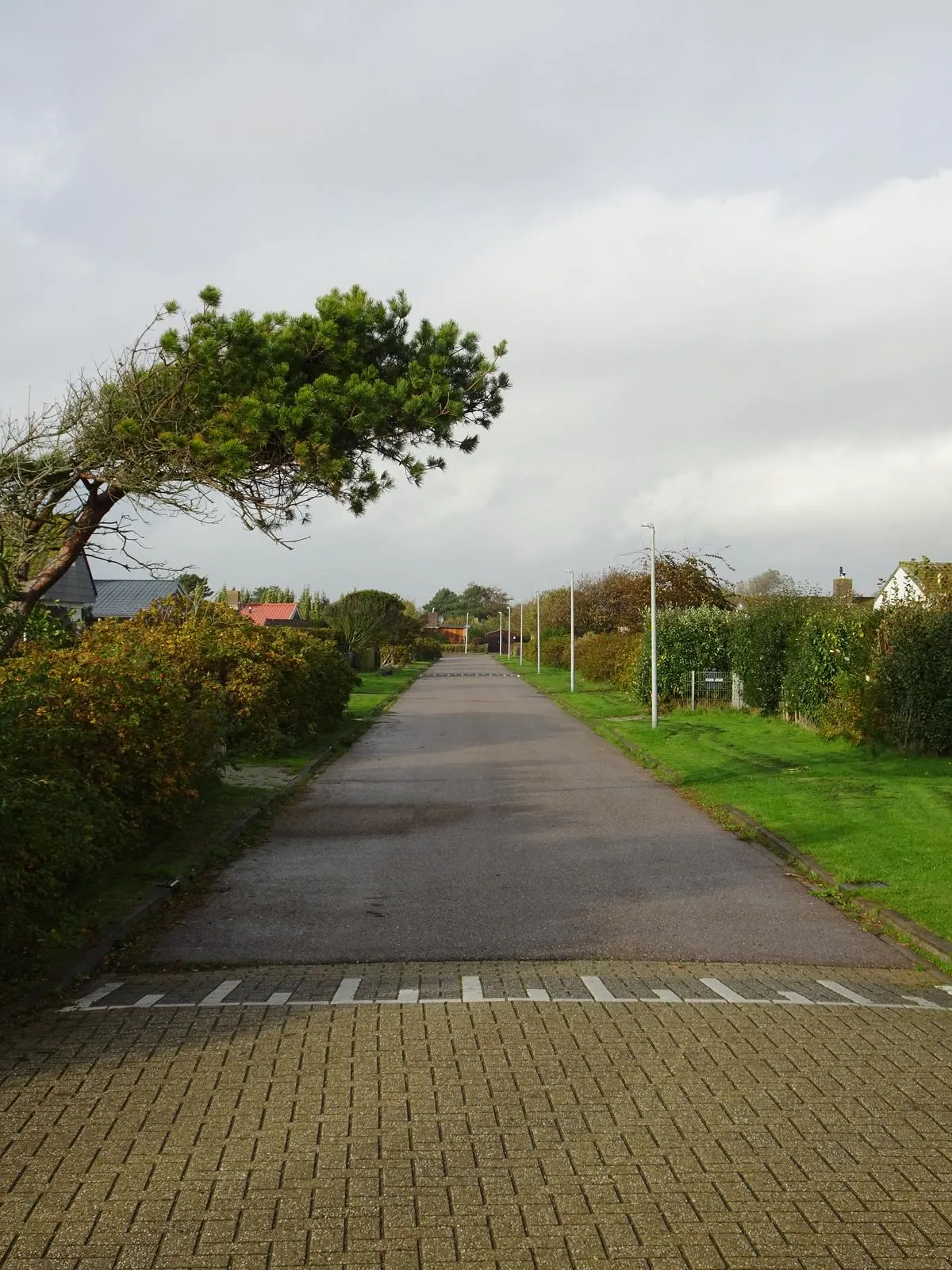
Kraaiheide lies on the western side of Den Helder, close to the dunes. Residential streets, footpaths and parking areas are a short distance from the sea. For the neighbourhood lighting, the smallest luminaire in a street lighting range was chosen: compact, yet with a high efficacy.
The result is a calm streetscape: by day the luminaires are barely noticeable, and in the evening they give enough light on carriageway and pavement without illuminating the dunes.
Lichtplein was not involved in this project; it serves here as an example of compact neighbourhood lighting on the coast, an approach you can also set up with our range.
Why compact works on the coast
A small luminaire has three advantages in a location like this:
- Less wind load. The luminaire's projected area counts towards the column load; on the coast a compact canopy leaves room for a slimmer column.
- Less salt deposit. A smooth, sealed IP66 housing keeps salt spray and drifting sand out.
- Lower wattage for the same light. At 130 to 160 lumens per watt, 25 to 50 W is in many cases enough for a residential street on a 4 to 6 metre column.
Lighting next to a nature reserve
As a guide value, residential streets need an average of 3 to 5 lux, footpaths 2 to 3 lux. More important than the lux figure are uniformity and the absence of spill light towards the dunes. Choose a luminaire with a flat underside and an optic that keeps the light on the road, and set the colour temperature to warm white: 2200 to 3000 K is calmer for residents and less disruptive for birds, bats and insects.
How to build this with the Lichtplein range
For the residential streets, the street luminaires of VIA fit well: adjustable from 20 to 50 W, 6,750 lumens, IP66, Type II optic, tilting on a 60 mm column spigot and with 10 kV surge protection as standard.
For small squares and footpaths, choose the modern post-top luminaires of POLARIS: 30, 40 or 60 W, colour temperature 2200, 3000 or 4000 K, symmetrical 90 degree beam, IP66, for a 60 to 80 mm column top. With the remote control from the same series you set output and colour per column after installation.
As the column, choose the steel columns of TURRIS in 4 or 6 metres, hot-dip galvanised and, on the coast, preferably powder-coated in RAL 9005, or the aluminium columns of CIVIS. The column fuse unit comes from the NEXUS series.
Points of attention for the installer
- Corrosion: close to the sea, allow for corrosivity category C4 to C5. Choose galvanised plus powder coating or aluminium, and stainless steel fixings.
- Sand and moisture: position the column with the door facing away from the sea wind and check that all glands are sealed.
- Lead time: luminaires within 5 working days from European stock, columns in 3 to 6 weeks. Order the columns first.
- Business only: Lichtplein supplies businesses only. Project prices apply from 100 luminaires and 20 columns.
Frequently asked questions
How much lux does a residential street need?
As a guide value, an average of 3 to 5 lux on the carriageway and 2 to 3 lux on footpaths. The column spacing follows from a lighting calculation; at a mounting height of 4 to 6 metres it is usually between 15 and 30 metres, depending on road width and optic.
Which colour temperature should I choose next to the dunes?
Warm white from 2200 to 3000 K. The POLARIS post-top luminaires are adjustable to 2200, 3000 or 4000 K; the VIA street luminaires are available in 2700 K.
Steel or aluminium column on the coast?
Both work. With steel, choose hot-dip galvanised with an additional powder coat; aluminium needs no coating of its own. Always have the column selection checked where wind loads are high.
Does a VIA luminaire fit a 4 metre column?
Yes. The luminaires tilt on a 60 mm spigot, and for 4 metres there is a compact 25 W model with 1,500 lumens.
Can Lichtplein produce the lighting design?
Yes. A lighting calculation for your neighbourhood or site costs 350 euros excluding VAT and gives column spacing, wattage and uniformity per street.
View the street luminaires of VIA and the post-top luminaires of POLARIS, or request a lighting calculation for your own coastal residential area.
Read also
 Knowledge
LED lighting before year end: KIA, EIA and planning for Dutch businesses
Many companies replace their lighting in the last months of the year. What the Dutch small-scale investment allowance (KIA) and energy investment allowance (EIA) can mean, what to watch out for and how to have the luminaires on site in time.
28 October 2026 Knowledge
Site lighting for the dark months: checklist for business sites and car parks
Once the clocks go back it is dark by half past four, and the first and last hour of the working day happen in the dark. How to check your outdoor lighting now, fill the gaps and have the luminaires on site before the shortest days.
25 October 2026 Knowledge
3000K, 4000K or 5000K: choosing colour temperature by application
Kelvin decides whether light looks warm, neutral or cool, and with it whether a street feels comfortable and a warehouse works well. We set out the right colour temperature for each application.
7 October 2026 Knowledge
IP and IK ratings explained: IP65, IP66, IP67, IP69K, IK08 and IK10
The IP rating tells you how well a luminaire resists dust and water, the IK rating how much impact energy the housing can take. Read what the figures mean, which rating you need in which environment and which series from our range fit the job.
6 October 2026