Worked example: a 2,000 m² poultry house with dimmable batten luminaires
How many dimmable batten luminaires does a 100 by 20 metre broiler house need, how do you lay out the rows and how do you drive the lighting programme? A fictional worked example with 60 W linear luminaires from the TRIVO range, including high-pressure cleaning.
Starting points of the example
This example is fictional, but the dimensions are familiar: a broiler house of 100 by 20 metres, so 2,000 m², with a flat ceiling 3 metres above the floor. The birds live on litter and the light level is measured at bird height, just above that litter. After every crop of six to seven weeks the house is emptied, washed down with a pressure washer and disinfected.
The poultry farmer, through his installer, sets four requirements:
- a lighting programme that steps down from 40 lux to 20 lux per phase, with a dusk phase when switching on and off;
- a working level of around 100 lux for inspection, vaccination, catching and cleaning;
- a housing that withstands pressure washing and ammonia, specified in the tender as at least IP67;
- no junction boxes in the animal area and as little cable as possible.
Light level and lighting programme
European welfare rules for broilers require a minimum of 20 lux during the light period, measured at bird height and over at least 80 per cent of the usable area; always check the current requirements that apply to the farm. A crop starts higher so that the chicks find feed and water. The programme in this example:
- Day 1 to 7: 30 to 40 lux, a long light period with a short dark phase;
- From day 8: 20 lux, with at least 6 hours of darkness per 24 hours, of which at least 4 hours uninterrupted;
- Dusk phase: 15 to 30 minutes of gradual dimming up and down, to below 5 per cent;
- Working level: 100 lux on demand, via a switch at the entrance or the climate computer.
The working level sizes the installation. If you design for 20 lux only, there is no reserve for the starting phase, for soiling or for people working in the house. We therefore design for 100 lux at 100 per cent and let the lighting programme do the rest: 40 lux is then roughly 40 per cent, 20 lux roughly 20 per cent.
The luminaire: a 60 W batten from TRIVO
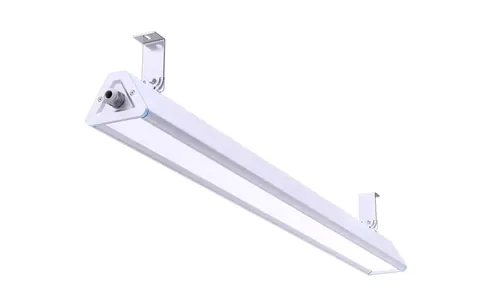
As the design value we take a waterproof 60 W batten luminaire from the TRIVO range. At 150 lumens per watt it delivers roughly 9,000 lumens. The luminaires are through-wired, so one supply cable per row is enough, and open without tools. For control we choose the version with a DALI-2 driver: every luminaire gets an address, every row becomes a group and the programme runs from the climate computer.
IP67 protects against temporary immersion but says nothing about high-pressure water jets. For a house that is washed down after every crop you specify IP69K, tested with hot water at 80 to 100 bar at close range; TRIVO is available in IP65 and IP69K. Check the driver's lower dimming limit: the dusk phase needs dimming down to 1 per cent, with the lowest possible flicker percentage even when dimmed, because poultry can perceive flicker that people do not see.
The calculation: from lux to number of luminaires
With the lumen method you work out the number of luminaires in one line: number = (lux × area) / (lumens per luminaire × utilisation factor × maintenance factor).
- Utilisation factor 0.5: a wide, low room with dark, soiled walls and litter on the floor reflects little light.
- Maintenance factor 0.7: dust and ammonia deposits on the diffuser plus the lumen depreciation of the LEDs over their life.
Filled in: 100 lux × 2,000 m² / (9,000 lm × 0.5 × 0.7) = 200,000 / 3,150 = 63.5 luminaires. Rounded to a logical layout, that gives 64 luminaires. New and clean, this installation delivers well over 140 lux; at the end of the maintenance cycle it still delivers the required 100 lux.
Rows, spacings and groups
A house 20 metres wide with luminaires at 3 metres calls for four rows along its length: 5 metres centre to centre, the outer rows 2.5 metres from the wall. Per row 16 luminaires at 6.25 metres centre to centre, the first a good 3 metres from the end wall. That puts the spacing-to-mounting-height ratio at a good 1.5 across the house and around 2 along it. With a wide-beam batten luminaire, a uniformity of around 0.5 at bird height is achievable, without dark lanes where the chicks crowd together; the lighting calculation has to confirm this.
Each row of 16 luminaires (960 W, a good 4 A) hangs on one through-wired supply cable and its own circuit. Mind the inrush current of the drivers: sixteen drivers on one B16 MCB may be too many, a C characteristic gives headroom. DALI-2 allows a maximum of 64 addresses per line, exactly the number of luminaires, but that leaves no room for a lux sensor or switching contact. So split the house over two DALI lines of two rows each and make every row its own group, so that you can adjust the rows above the feed lines separately.
High-pressure cleaning
An IP69K luminaire withstands pressure washing, but not everything. Keep the lance at least half a metre away and do not aim directly at gaskets and end caps. Clean only de-energised, cooled-down luminaires: a hot housing that cools suddenly draws moisture inside. Let the luminaires dry after disinfection before the power comes back on and check the clips at every crop.
Choose materials that tolerate ammonia and disinfectants: housing and diffuser in polycarbonate, clips in stainless steel. Avoid bare aluminium and galvanised parts in the animal area. Because the TRIVO luminaires open without tools, the driver stays accessible after years without seized screws.
What it costs and how to proceed
Lichtplein supplies businesses only. Batten luminaires from TRIVO range from 46 to 129 euros excluding VAT each, depending on wattage, IP rating and driver. From 100 units a project price applies: if the farm has two houses, 128 luminaires qualify. Delivery from European stock within 5 working days. For the yard and loading area, combine the house with floodlights from FLUX or a street luminaire from VIA on a steel column from TURRIS.
On energy: 64 × 60 W is 3.84 kW connected, but in the 20 lux phase the installation runs at around 20 per cent, roughly 0.8 kW, which at 18 hours of light is in the order of 15 kWh per day. Lichtplein provides a lighting calculation with the luminaire's actual light distribution and a drawing of the rows for 350 euros excluding VAT, so the poultry farmer sees the lux values at bird height and the uniformity in advance.
Frequently asked questions
Why design for 100 lux when broilers need 20 lux?
Because 20 lux is the minimum at bird height at the end of the maintenance cycle, not the design target. The reserve covers the 30 to 40 lux starting phase, soiling of the diffuser and working light for people. With DALI-2 you simply dim the rest away.
Is IP67 not enough for a poultry house?
IP67 protects against temporary immersion, not against high-pressure water jets. If the house is washed down after every crop, choose IP69K. For low-pressure cleaning IP65 is sufficient.
How many luminaires fit on one DALI line?
A maximum of 64 addresses and 16 groups per line. Reserve addresses for sensors and switching contacts and split a large house over two lines, in this example two rows per line.
Is every TRIVO version available with DALI-2 and IP69K?
Not every combination of wattage, IP rating and driver is a standard version. For broilers, warm light of 2700 to 3000 K is also often requested. State the cleaning regime, the control you want and the colour temperature in your enquiry and we will propose the matching version, with up to 5 years' warranty.
Can I use the same approach for a layer or pig house?
Yes, only the lux values and the lighting programme differ. For pigs, European welfare rules require at least 40 lux for a minimum of 8 hours per day; laying hens have their own requirements for light level and day length, which you check in the current regulations. The factors 0.5 and 0.7 and the layout in rows remain usable.
Would you like this layout calculated for your own poultry house? Request a lighting calculation or send the dimensions and lighting programme via the quotation page, and we will propose the matching version from the TRIVO range.
Read also
 Worked examples
Worked example: a 4,000 m² warehouse from fluorescent to LED high bay
A fictional hall of 80 by 50 metres, 10 metres high, 200 lux required. Step by step we work out how many 150 W UFO high bays are needed, what that saves per year in kWh compared with fluorescent, and what sensors add on top.
8 October 2026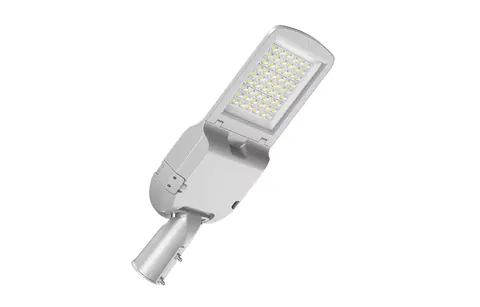 Knowledge
3000K, 4000K or 5000K: choosing colour temperature by application
Kelvin decides whether light looks warm, neutral or cool, and with it whether a street feels comfortable and a warehouse works well. We set out the right colour temperature for each application.
7 October 2026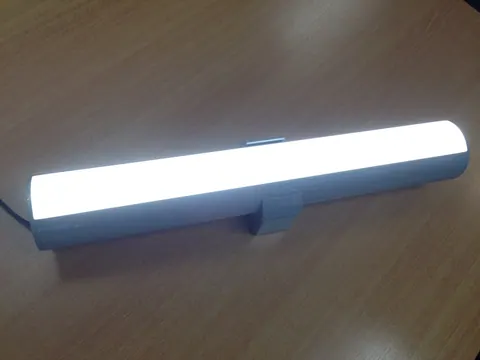 Knowledge
IP and IK ratings explained: IP65, IP66, IP67, IP69K, IK08 and IK10
The IP rating tells you how well a luminaire resists dust and water, the IK rating how much impact energy the housing can take. Read what the figures mean, which rating you need in which environment and which series from our range fit the job.
6 October 2026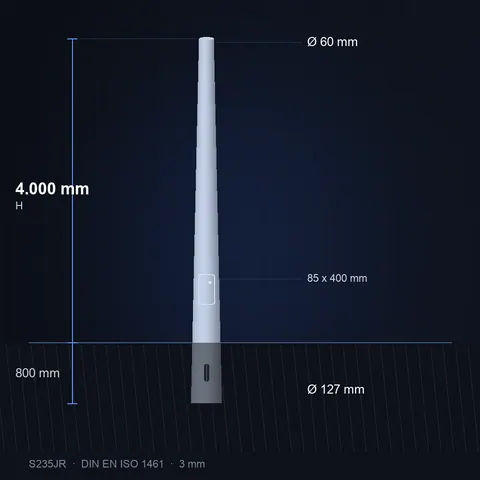 Worked examples
Worked example: car park with 12 columns of 6 metres
A fictional car park of 100 by 60 metres needs 20 lux from twelve steel lighting columns of 6 metres. We work out step by step how much light is required, which VIA street luminaires fit and what the complete bill of materials costs, indicatively.
6 October 2026