Sassenheim: comfortable light without glare
In a municipal street in Sassenheim, a plainly styled street luminaire with two independent light sources delivers roughly 1,500 to 15,000 lumens. Why that simplicity keeps glare low, and how you achieve the same with the adjustable street luminaires of VIA.
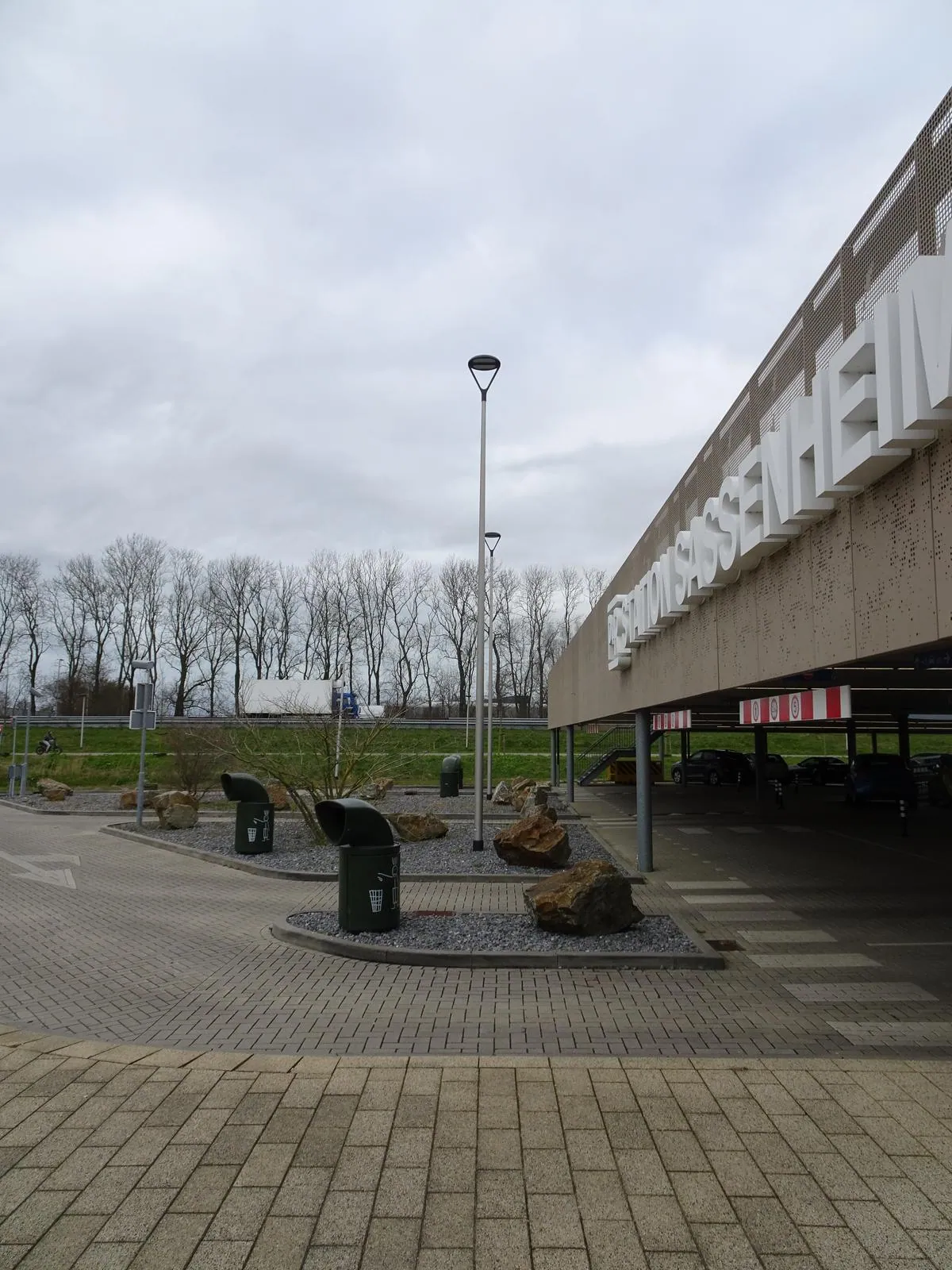
The street in Sassenheim
Sassenheim, in the municipality of Teylingen, has the residential streets typical of a Dutch village: cars, cyclists and pedestrians share the same space. The columns are low, at 4 to 6 metres, the house fronts close to the road. A luminaire at 4 metres hangs almost in a cyclist's line of sight: glare is a real risk.
When the lighting was renewed, the choice fell on a street luminaire with a clean, simple housing: no decorative canopy or protruding lens, just a flat light window that directs the light downwards and along the road. Lichtplein was not involved in this project. We describe it because the design choices behind it apply directly to luminaires from our range.
Two light sources, one housing
The luminaire works with two independent light sources. Each source has its own optic, chosen from several light distributions, and its own lumen output. Together they deliver roughly 1,500 to 15,000 lumens, depending on the setting. The same housing therefore suits a footway with one source at low output as well as a through road with two sources at full output.
One luminaire type for the whole neighbourhood, then, with its own setting on every column.
Why the shape limits glare
Glare on the street comes from light reaching the eye at a shallow angle. EN 13201 limits it with intensity classes (G classes) for the luminous intensity at 70, 80 and 90 degrees. A flat optic mounted horizontally meets the stricter classes almost by itself: no light above the horizon, little light towards the road user.
A luminaire without a domed cover or translucent side walls emits only through its light window. With a warm colour temperature of 2700 or 3000 K you see the road, not the lamp.
How you achieve the same with VIA
The street luminaires of VIA follow the same principle: a flat housing, a Type II or Type III optic and an output you set per luminaire. The series runs from 25 to 100 W; on the dip switch versions you select the output on site. That gives roughly 1,500 to 15,000 lumens depending on the version, with an efficacy of up to 160 lm/W: the same range as in Sassenheim.
- Footway or narrow residential street: 25 W, 1,500 lm, Type II optic, mounting height 4 metres.
- Through road in a neighbourhood: 50 to 100 W, Type III optic, mounting height 6 metres.
- All versions: IP66, 10 kV surge protection, tilting on a 60 mm spigot, 5 year guarantee.
Set the tilt angle to 0 degrees: every degree upwards raises the luminous intensity in the glare zone and the light entering bedrooms. For dimming back after midnight, choose the version with DALI-2 and D4i or a driver with AstroDIM.
Lighting level and columns
Residential streets are usually assigned class P3 or P4 from EN 13201: an average of 7.5 or 5 lux with a minimum of 1.5 or 1 lux. At 4 metres, 25 to 40 W per lighting point is often enough for P4, depending on column spacing; a lighting calculation confirms the uniformity in advance. For the columns, the conical steel columns of TURRIS in 4 and 6 metres fit, with a NEXUS cut-out (column connection box) in the door opening.
Frequently asked questions
Does VIA also have two light sources in one luminaire?
No, VIA works with one adjustable light source per luminaire. You cover the same range of roughly 1,500 to 15,000 lumens by choosing the right version and setting its output; the series runs from 25 to 100 W. At junctions you can combine two luminaires on one column.
How do I avoid glare on a 4 metre column?
Mount the luminaire horizontally (0 degrees), choose a flat optic with no upward light and keep the output modest: 25 to 40 W is usually enough at 4 metres. A warm colour temperature of 2700 K helps as well.
Which optic suits a residential street?
Type II for narrow streets and footways with the column close to the kerb, Type III for wider carriageways. VIA offers both.
Can I change the output later?
Yes. On the dip switch versions you change the output on site inside the luminaire; on the DALI-2 versions you adjust the dimming profile from the control system.
Need to light a street with low columns without glare? View the adjustable street luminaires of VIA or request a lighting calculation. Lichtplein supplies businesses only.
Read also
 Knowledge
LED lighting before year end: KIA, EIA and planning for Dutch businesses
Many companies replace their lighting in the last months of the year. What the Dutch small-scale investment allowance (KIA) and energy investment allowance (EIA) can mean, what to watch out for and how to have the luminaires on site in time.
28 October 2026 Knowledge
Site lighting for the dark months: checklist for business sites and car parks
Once the clocks go back it is dark by half past four, and the first and last hour of the working day happen in the dark. How to check your outdoor lighting now, fill the gaps and have the luminaires on site before the shortest days.
25 October 2026 Knowledge
3000K, 4000K or 5000K: choosing colour temperature by application
Kelvin decides whether light looks warm, neutral or cool, and with it whether a street feels comfortable and a warehouse works well. We set out the right colour temperature for each application.
7 October 2026 Knowledge
IP and IK ratings explained: IP65, IP66, IP67, IP69K, IK08 and IK10
The IP rating tells you how well a luminaire resists dust and water, the IK rating how much impact energy the housing can take. Read what the figures mean, which rating you need in which environment and which series from our range fit the job.
6 October 2026