UGR: glare in halls and offices and why UGR<21 matters
The Unified Glare Rating captures in one figure how much discomfort glare a lighting installation causes at the workplace. This article explains which UGR limit applies where, why a UFO high bay in a low hall is often too bright, and how flat high bays, light lines, mounting height and optics keep you below UGR 19 or 22.
What the UGR value tells you
UGR stands for Unified Glare Rating, a CIE calculation method that expresses discomfort glare from indoor lighting as a single number. In practice the scale runs from 10 (barely perceptible) to 28 (disturbing). The lower, the less glare. A difference of 1 point is barely noticeable; 3 points is clearly felt. That is why the standards work in steps of 3: UGR 13, 16, 19, 22, 25 and 28.
Four things count in the calculation: the luminance (brightness) of each luminaire in the viewing direction, the size of the luminous surface as seen from the eye, the position relative to the line of sight, and the brightness of ceiling and walls. A small, bright point just above the line of sight scores badly; a large, evenly lit surface high in the ceiling scores well. UGR applies indoors only. Outdoors, on sites and sports pitches, the GR value is used.
Which UGR limit applies where
The workplace lighting standard EN 12464-1 links each task to an illuminance in lux and a maximum UGR. The most common combinations:
- Office work (writing, reading, screen work) and meeting rooms: 500 lux, UGR 19.
- Technical drawing: 750 lux, UGR 16.
- Reception desks: 300 lux, UGR 22.
- Archives and store rooms: 100 to 200 lux, UGR 25.
- Warehouses, dispatch and packing: 300 lux, UGR 25.
- Rough and medium machine work: 200 to 300 lux, UGR 25. Fine machine work: 500 lux, UGR 22.
- Corridors and circulation areas: 100 lux, UGR 28.
Sports halls fall under the separate sports lighting standard EN 12193, with roughly 200 to 750 lux depending on the sport and the level of play. Because players in ball sports often look straight up, low glare matters there at least as much as in an office. Note the difference: an installation that achieves UGR 22 in a hall is not yet good enough for an office with screens, where 19 is the limit.
Why a UFO high bay in a low hall quickly dazzles
A 100 W UFO high bay delivers 15,000 to 18,000 lumens from a luminous surface of roughly 30 centimetres across: a very bright source. At 10 or 12 metres that is no problem, the luminaire hangs well outside the normal viewing direction and looks small from the floor. At 5 or 6 metres, as in many workshops and sports halls, a forklift driver or order picker regularly looks straight at it. The UGR then easily exceeds 25.
A flat high bay spreads the same luminous flux over a much larger surface, behind an opal or microprismatic cover. The luminance per square centimetre drops sharply and the UGR with it. That is the difference between a luminaire that stands out and a hall that is simply well lit.
Flat high bays and light lines with UGR<21
For halls up to about 8 metres and for sports halls we offer flat LED high bays with UGR<21 in the ATRIA range. The 120 W version delivers 19,200 lumens (160 lm/W) with a 110° beam, is IP65 and IK10, 0-10V dimmable and carries a 5 year warranty. Above racking, the linear ATRIA high bay with 30x90° optics is the better fit: the beam falls into the aisle and not into the eyes of the driver in the next aisle. The UFO versions of ATRIA, up to 180 lm/W, remain the most efficient choice for high halls where the mounting height already limits glare.
For offices and retail, the LINEA light lines are designed for UGR<21: seamlessly linkable, in white or black, surface mounted or suspended, with adjustable output from 24 to 40 W. The optional indirect uplight module sends part of the light to the ceiling. That raises the background luminance, reduces the contrast with the luminaire and lowers the calculated UGR further.
Mounting height and optics: how you steer the UGR
As an installer you have more influence on the UGR than the choice of luminaire alone. The main levers:
- Mounting height: mounting higher shrinks the luminous surface for the eye and moves the luminaire out of the viewing direction. Below 6 metres, prefer flat or linear; above 8 metres a UFO is usually fine.
- Beam angle and optics: a narrower beam sends less light at shallow angles towards the eyes; a diffuse cover lowers the luminance of the luminous surface.
- Orientation: with light lines and linear luminaires the UGR lengthwise differs from the UGR crosswise. Run the lines parallel to the main viewing direction and check both values.
- Reflectance: a light ceiling and light walls raise the background luminance and lower the UGR. The same luminaires score worse in a dark hall.
- Eye height: the calculation places the eye at 1.2 metres for seated work. A forklift driver sits higher and looks up more often; include that position.
Luminaire UGR versus UGR in your project
The UGR on a datasheet is a table value from the CIE method for a standard room with reflectances of 70, 50 and 20 per cent for ceiling, walls and floor. Your hall or office always differs from that. The real UGR only follows from a lighting calculation with your dimensions, mounting height, luminaire layout and viewing positions. A luminaire with UGR<21 can exceed 22 in a low, dark hall and stay below 19 in a bright office with the right layout.
Lichtplein produces such a lighting calculation for 350 euros excl. VAT, with lux levels, uniformity and UGR per viewing position. From 100 luminaires we quote project prices. We supply businesses only, from European stock within 5 working days.
Frequently asked questions
Is a luminaire with UGR<19 always right for an office?
No. The datasheet value applies to a standard room. Mounting height, luminaire layout, viewing direction and the reflectance of ceiling and walls determine the real UGR in your office. Have it calculated.
Does UGR also apply to outdoor lighting?
No. UGR is a method for indoor spaces. Outdoors, on sites and sports pitches, the GR value is used.
Can I solve glare by dimming?
Dimming via DALI or 0-10V lowers the luminance and therefore the UGR, but also the illuminance. If the hall is already tight at 300 lux, that is no solution. Choose a flat or linear luminaire instead, or mount higher.
Which UGR should I aim for in a sports hall?
The sports standard sets its own requirements, but because players look upwards, flat high bays with UGR<21 are a safe choice. Have the glare calculated per viewing direction in the lighting plan.
Browse the flat and linear high bays in the ATRIA range and the LINEA light lines, or request a lighting calculation so you know for certain that your project stays below UGR 19 or 22.
Read also
 Knowledge
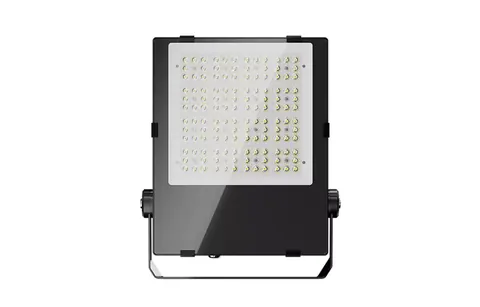
LED lighting before year end: KIA, EIA and planning for Dutch businesses
Many companies replace their lighting in the last months of the year. What the Dutch small-scale investment allowance (KIA) and energy investment allowance (EIA) can mean, what to watch out for and how to have the luminaires on site in time.
28 October 2026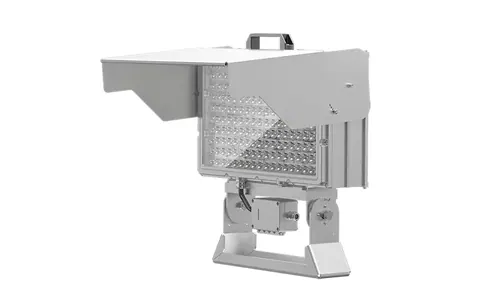 Knowledge
Site lighting for the dark months: checklist for business sites and car parks
Once the clocks go back it is dark by half past four, and the first and last hour of the working day happen in the dark. How to check your outdoor lighting now, fill the gaps and have the luminaires on site before the shortest days.
25 October 2026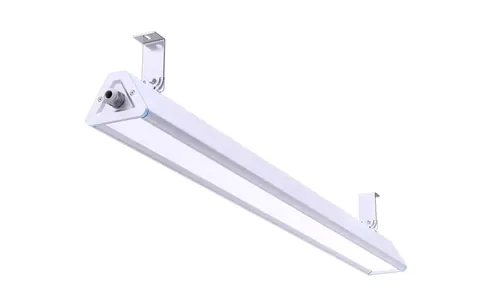 Worked examples
Worked example: a 4,000 m² warehouse from fluorescent to LED high bay
A fictional hall of 80 by 50 metres, 10 metres high, 200 lux required. Step by step we work out how many 150 W UFO high bays are needed, what that saves per year in kWh compared with fluorescent, and what sensors add on top.
8 October 2026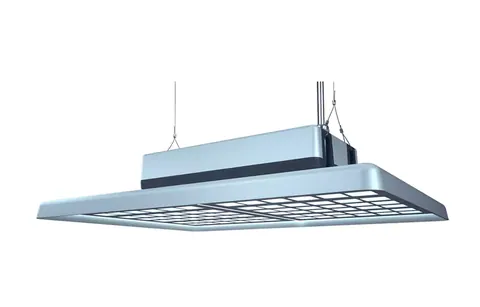 Knowledge
UFO or linear high bay: which one for your warehouse or hall
A high bay comes as a round UFO, as a linear luminaire above the racking aisle and as a flat panel with UGR<21. Which one you choose depends on mounting height, racking and the work done in the hall. This article gives the selection rules and a worked example for the number of luminaires.
8 October 2026