Ecodesign and the energy label for light sources: what it means for LED luminaires
Since September 2021 the EU has applied new ecodesign requirements to light sources and separate control gear, together with an energy label from A to G. What the rules cover, why luminaires themselves no longer carry a label and what to check as an installer.
Two regulations since September 2021
Since September 2021 two regulations apply side by side in the EU: ecodesign, with minimum requirements for light sources and separate control gear (drivers), and the energy label with a new scale from A to G. The old scale up to A++ has gone.
The biggest change from the old rules: the label belongs to the light source, not to the luminaire. The separate luminaire label, which showed which lamp classes fitted a luminaire, has been withdrawn.
What ecodesign requires
The main minimum requirements for a light source placed on the EU market:
- a minimum luminous efficacy in lumens per watt, which ruled out halogen and most fluorescent lamps
- a colour rendering index Ra of at least 80, with exceptions for outdoor and industrial applications
- limits on flicker (Pst LM no more than 1.0) and stroboscopic effect (SVM no more than 0.4 since September 2024)
- standby consumption of no more than 0.5 W
- a displacement factor (power factor) of at least 0.9 for light sources above 100 W
- an endurance test with switching cycles
In addition, the light source and driver in a luminaire must be replaceable with commonly available tools, unless the manufacturer gives a technical justification for why this is not possible. Separate drivers have their own minimum efficiency requirements. For the street luminaires of VIA, for example, the driver is available separately, so you replace only the driver in case of a fault.
The scale from A to G
The class follows from the total luminous efficacy of the light source, including the losses in the driver. The thresholds: A from 210 lm/W, B from 185, C from 160, D from 135, E from 110, F from 85 and G below that. Class A was deliberately left almost empty at launch, as headroom for future LED technology.
The label value is not the datasheet lm/W one to one: the calculation uses the useful luminous flux within the beam and a correction factor for light source type and driver. So compare luminaires with each other on the datasheet, and separate light sources with each other on the label.
Every label carries a QR code linking to the European product database EPREL. There you find the product information sheet with lifetime, colour rendering and flicker values.
Luminaires with fixed LED
In the regulation a luminaire is a containing product. If the LED module can be removed from the luminaire without permanent damage, that module is the light source and the luminaire itself carries no label. The supplier must still be able to show that the built-in light source and driver meet the requirements. If the LED cannot be removed without damaging the luminaire, the whole luminaire counts as the light source, with all requirements and the label.
For you as an installer this means: a label on a high bay or linear luminaire is not compulsory, and its absence says nothing about quality. Look at what you can check: lm/W, lifetime as L70 or L80, replaceability of the driver and the warranty. The high bays of ATRIA reach up to 180 lm/W, the light lines of LINEA suit offices with UGR<21, and both come with a 5 year warranty.
What disappeared from the market
The requirements have clearly changed the range on offer. Halogen had largely gone already, compact fluorescent lamps with integrated ballast followed in 2021. In 2023 the exemptions for T8 and T5 fluorescent tubes expired: they may no longer be placed new on the EU market. Existing installations may keep running and trade stock may be sold, but supply stops.
For car parks, livestock buildings and warehouses with fluorescent fittings, replacement is therefore a matter of time. A complete LED linear luminaire such as TRIVO (IP65, through-wired) is often cheaper to maintain than retrofit tubes in outdated fittings, because the driver, optics and housing are then new as well.
Purchasing checklist
- Ask for the datasheet of every luminaire with lm/W, L value and flicker data.
- Check whether the LED module and driver are replaceable and whether the driver is available separately.
- For separate light sources, check the label and the EPREL registration via the QR code.
- Have a lighting calculation made for larger spaces, so you work in lux rather than only in watts.
Frequently asked questions
Does an LED luminaire need an energy label?
No. The label applies to light sources. Only if the LED cannot be removed from the luminaire without damage does the luminaire itself count as a light source that must be labelled. Most professional luminaires therefore carry no label; you compare them on the datasheet.
Why is the label class lower than I expect from the lm/W?
The label uses the useful luminous flux and a correction factor, and class A was left almost empty on purpose. A datasheet value of 160 lm/W therefore does not automatically mean class C. Compare luminaires on the datasheet and separate light sources on the label.
May I still replace fluorescent tubes in existing fittings?
Yes, tubes already placed on the market may be sold and used. New T8 and T5 tubes are no longer being placed on the EU market, so stocks are finite. Plan the switch to LED, as a retrofit or as a new luminaire.
Do the requirements also apply to separate LED drivers?
Yes. Separate control gear must meet minimum efficiency requirements. For the street luminaires of VIA the driver is available separately, so you replace a driver rather than the whole luminaire.
View the high bays of ATRIA and the light lines of LINEA, or let us prepare a lighting calculation for your project. Lichtplein supplies businesses only.
Read also
 Knowledge
LED lighting before year end: KIA, EIA and planning for Dutch businesses
Many companies replace their lighting in the last months of the year. What the Dutch small-scale investment allowance (KIA) and energy investment allowance (EIA) can mean, what to watch out for and how to have the luminaires on site in time.
28 October 2026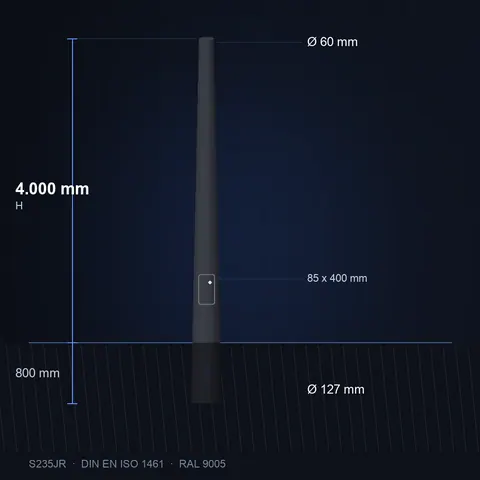 News
New: steel and aluminium lighting columns to the Dutch standard
Lichtplein now supplies conical steel lighting columns of 4 and 6 metres at a sharp price on request, plus aluminium columns of 3, 4 and 6 metres. With full dimensions on the product page, matching our street and post-top luminaires, delivered by truck.
8 October 2026 Worked examples
Worked example: a 4,000 m² warehouse from fluorescent to LED high bay
A fictional hall of 80 by 50 metres, 10 metres high, 200 lux required. Step by step we work out how many 150 W UFO high bays are needed, what that saves per year in kWh compared with fluorescent, and what sensors add on top.
8 October 2026 Knowledge
UFO or linear high bay: which one for your warehouse or hall
A high bay comes as a round UFO, as a linear luminaire above the racking aisle and as a flat panel with UGR<21. Which one you choose depends on mounting height, racking and the work done in the hall. This article gives the selection rules and a worked example for the number of luminaires.
8 October 2026