EN 40: what a lighting column must comply with
A lighting column is a construction product and falls under the European standard series EN 40. What that standard covers for design, wind load, steel and aluminium, and which documents you as an installer should expect with a delivery.
What EN 40 covers
EN 40 is the European standard series for lighting columns. The series covers everything from definitions and dimensions to the requirements per material:
- EN 40-1 and EN 40-2: definitions, general requirements and dimensions, such as the size of the spigot the luminaire slides onto.
- EN 40-3: design and verification, with the loads and the check by calculation or by testing.
- EN 40-5: steel lighting columns.
- EN 40-6: aluminium lighting columns.
- EN 40-4 and EN 40-7: concrete columns and fibre reinforced polymer composite columns.
For installers, EN 40-5 and EN 40-6 matter most: the CE marking of a steel or aluminium column is based on them.
Wind is the governing load
A lighting column carries little weight but catches a lot of wind. EN 40-3-1 derives the characteristic load from the wind speed at the location, the terrain category (open coast or sheltered built-up area), the column height and the wind area of column and luminaire together. The Netherlands has three wind zones; the coastal strip carries the heaviest load.
The manufacturer verifies the strength by calculation (EN 40-3-3) or by testing (EN 40-3-2). The result is a maximum top load: the weight and wind area of the luminaire the column may carry. Fit a heavier or larger head and that verification no longer applies. Check this before you combine a street luminaire from VIA or a post-top luminaire from POLARIS with a column.
The standard also assesses the deflection of the top under wind, divided into classes. A stiff column keeps precisely aimed optics where they belong.
Steel and aluminium
Steel (EN 40-5) sets requirements for the steel grade (for example S235JR), the welded joints and the corrosion protection. Hot-dip galvanising to EN ISO 1461 is the basis; a powder coating on top adds protection and the required colour, such as RAL 9005 on the TURRIS columns.
Aluminium (EN 40-6) sets requirements for the alloy and the heat treatment. The wind load the column has to carry is the same as for a steel column of equal height; the manufacturer achieves that strength with the right alloy, wall thickness and diameter. Aluminium does not rust and weighs roughly a third of steel by volume, which makes installation easier. The CIVIS columns are based on these requirements.
CE marking and Declaration of Performance
Lighting columns fall under the European Construction Products Regulation. EN 40-5 and EN 40-6 are harmonised standards, so a steel or aluminium column must carry a CE marking with a Declaration of Performance (DoP). In it the manufacturer declares, among other things, the resistance to horizontal loads, the deflection and the durability. For columns beside the carriageway, the behaviour under vehicle impact to EN 12767 may be added.
The CE marking says nothing about the light, but it does say that the structure has been verified and that production is under control. A column without a Declaration of Performance does not belong in a public space.
Which documents to expect
Ask for these documents with every delivery, certainly on projects:
- Declaration of Performance (DoP) referring to EN 40-5 or EN 40-6.
- Dimensional drawing with mounting height, planting depth, spigot size, door opening and cable entry.
- Maximum top load: permitted weight and wind area of the luminaire.
- Corrosion protection: zinc coating thickness and any powder coating.
- Installation instructions: planting depth, backfill and earthing.
Mind the difference between mounting height and overall length: part of the column goes into the ground, usually 0.8 to 1 metre. The door opening must stay above ground level so the NEXUS column cut-out remains accessible. Our street luminaires fit a 60 mm spigot.
Frequently asked questions
Is EN 40 mandatory?
In practice, yes, for steel and aluminium lighting columns in public space: EN 40-5 and EN 40-6 are harmonised standards under the Construction Products Regulation, so CE marking and a Declaration of Performance are required.
Can I fit any luminaire on an EN 40 column?
Only within the stated maximum top load for weight and wind area. If in doubt, send us the luminaire's datasheet.
What is the difference between EN 40 and EN 12767?
EN 40 covers the strength and construction of the column. EN 12767 covers passive safety: how the column behaves when hit by a vehicle, relevant along roads with traffic.
Does the column's CE marking say anything about the light?
No. The column is a construction product. The luminaire has its own CE marking and specifications; for the combination you make a lighting calculation.
Read also
 Knowledge
LED lighting before year end: KIA, EIA and planning for Dutch businesses
Many companies replace their lighting in the last months of the year. What the Dutch small-scale investment allowance (KIA) and energy investment allowance (EIA) can mean, what to watch out for and how to have the luminaires on site in time.
28 October 2026 Knowledge
Site lighting for the dark months: checklist for business sites and car parks
Once the clocks go back it is dark by half past four, and the first and last hour of the working day happen in the dark. How to check your outdoor lighting now, fill the gaps and have the luminaires on site before the shortest days.
25 October 2026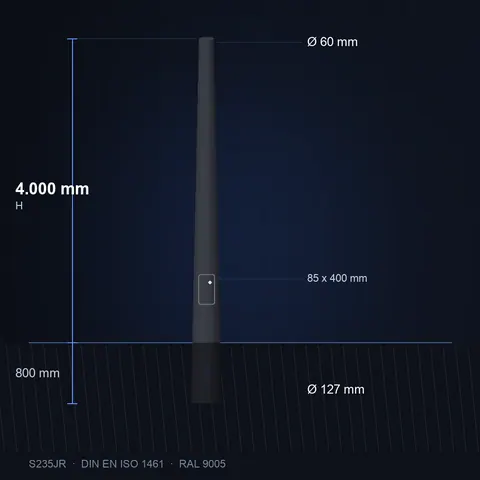 News
New: steel and aluminium lighting columns to the Dutch standard
Lichtplein now supplies conical steel lighting columns of 4 and 6 metres at a sharp price on request, plus aluminium columns of 3, 4 and 6 metres. With full dimensions on the product page, matching our street and post-top luminaires, delivered by truck.
8 October 2026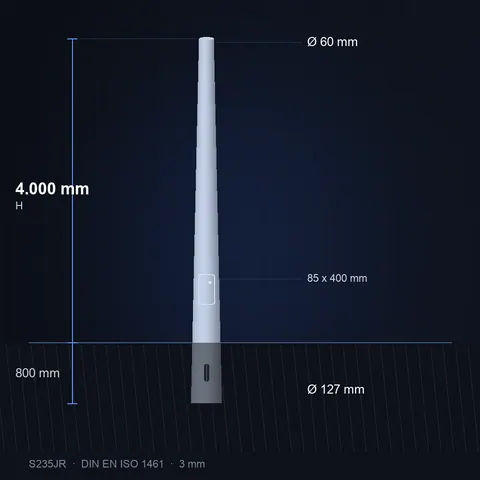 Worked examples
Worked example: car park with 12 columns of 6 metres
A fictional car park of 100 by 60 metres needs 20 lux from twelve steel lighting columns of 6 metres. We work out step by step how much light is required, which VIA street luminaires fit and what the complete bill of materials costs, indicatively.
6 October 2026