Column connection box and fuses: what a lighting column needs
Every lighting column needs a connection box behind its access door, where the underground cable is looped through and the luminaire gets its own fuse. Here is what the Dutch standard LS94 box does, how you choose between one and two fuses and what to order per column.
What the connection box behind the door does
At the bottom of every lighting column, behind the access door, sits the column connection box. Here the underground cable of the lighting network comes in, is looped through to the next column and branches off into the column cable up to the luminaire. The same box holds the fuse for the luminaire.
The box has three jobs:
- Looping through: incoming and outgoing mains cable on the same terminals, so the whole street runs on one cable.
- Protection: each luminaire gets its own fuse, so a short circuit in one column does not take down the whole circuit.
- Safe working: unscrew the cap and the luminaire is dead, while the rest of the street stays lit.
On the steel columns of TURRIS the 85 x 400 mm access door sits 500 mm (4 metre column) or 600 mm (6 metre column) above ground level. Inside the column is a C-rail to which you fix the box; the door closes with a triangular lock.
One or two fuses: which box to choose
The NEXUS range has two column connection boxes to the Dutch standard LS94: a version for two fuses and a version for one fuse with phase selection.
The single-fuse box is the standard choice for a column with one luminaire, which covers most residential streets, car parks and business parks. Choose the two-fuse box when two loads sit on the column: two luminaires on a double bracket, a luminaire plus a supply for festive lighting or a camera, or an evening and night switching scheme with two separately switched circuits.
If in doubt, take the two-fuse box. A second fuse position saves you replacing the box later.
Phase selection: spreading columns over L1, L2 and L3
A lighting network is usually fed by a three-phase cable. Put all columns on the same phase and the load is unbalanced and the voltage at the end of a long run drops unnecessarily. So you spread the columns over the three phases: column 1 on L1, column 2 on L2, column 3 on L3, and so on.
The box with phase selection makes this simple: with a pin the installer selects in the box which phase feeds the luminaire, without swapping cores. If one phase is switched off at night, the phase selection also decides which columns stay lit. Record the phase sequence in the lighting design, so it is still right after a fault or an extension.
Fuses E27/DII: 2, 4 or 6 ampere
The fuses are DII cartridge fuses with an E27 screw thread, the familiar D system. The cartridge sits in a porcelain screw cap: blown, cap out, swap the cartridge, cap in. No tools, no loose wires.
The NEXUS range includes cartridges of 2 A, 4 A and 6 A. Public lighting usually uses 6 A, sometimes 2 A. An LED street luminaire of 25 to 100 W draws roughly 0.1 to 0.5 A at 230 V, so the fuse mainly protects the column cable and has to withstand the inrush current of the LED driver, which is briefly much higher. Guideline:
- 6 A: the common choice in public lighting, also with two luminaires on one column or a driver with a high inrush current.
- 4 A: one luminaire of 50 to 100 W, such as a POLARIS post-top luminaire at 60 W, where the specification asks for a lower rating.
- 2 A: one luminaire up to about 50 W, such as a VIA street luminaire on a 4 metre column, where tight protection is wanted.
Follow the specification or the rules of the network operator, and check the inrush current in the driver specification and the discrimination with the circuit protection in the distribution board.
Earth braid and cable entry
A steel column is a conductive object in the street and must be connected to the protective conductor. The NEXUS earth braid is 300 mm long, 6 mm² and has lugs for M6 and M8: one end on the earth terminal of the box, the other on the earthing point of the column or door. Do not forget the braid when ordering; without that connection the column is not earthed and the installation does not comply.
The underground cable enters through the cable entry in the root section. TURRIS columns have two entries of 50 x 150 mm, opposite each other at 0 and 180 degrees, so the cable runs on in line with the street. Edge protection on the entry and a heat-shrink sleeve at ground level protect the cable sheath and the column; ask for them in your quote. From the box a column cable, usually 3G1.5 or 3G2.5, runs up to the luminaire on the 60 mm spigot.
Why the Dutch standard LS94
In the Netherlands the connection box, access door and mounting rail have been matched to each other for years. A box to LS94 fits the door of Dutch standard columns with a diameter of 94 mm or more at door height and is fixed to the C-rail. One type of box and one type of fuse therefore serves a whole municipality or business park.
So do not improvise with a random plastic enclosure. The standard box has five terminals (three phases, neutral and earth) for looping through, each taking two cores of 10 mm² or three cores of 6 mm², a fixed position for the fuses and automatic earthing. It is CE marked and fits without drilling in the steel columns of TURRIS and the aluminium columns of CIVIS.
How to order per column
Count the following lines per lighting point:
- 1 column, for example TURRIS 4 or 6 metres
- 1 column connection box LS94, for one fuse with phase selection or for two fuses
- 1 or 2 porcelain screw caps E27/DII
- 1 or 2 fuses of 2, 4 or 6 A, plus spares in the van
- 1 earth braid 300 mm, 6 mm²
- 1 luminaire for a 60 mm spigot
Connection boxes and accessories are priced on request; you receive a unit price with your quote. Boxes, screw caps and earth braids are available per unit and packed per 20, fuses per 25. Allow 3 to 6 weeks delivery for columns; project prices for columns apply from 20 units. Put column, box and luminaire in one quote and we check straight away that spigot, door and fuse match. Lichtplein supplies businesses only.
Frequently asked questions
Do I need a separate connection box for every column?
Yes. Each column gets one box behind the access door, where the underground cable is looped through and the luminaire gets its own fuse. Order as many boxes as columns.
Which fuse do I choose for a 40 W LED street luminaire?
In public lighting 6 A is the usual rating, also for a 40 W luminaire that draws less than 0.2 A. If the specification asks for tighter protection, 2 A is possible, provided the inrush current of the driver allows it. Always check the driver specification.
What is the difference between E27 and DII?
It is the same fuse. DII is the size in the D system (cartridges up to 25 A), E27 is the screw thread of the matching cap. In a column box you use cartridges of 2 to 6 A.
Does the box also fit an existing column from another manufacturer?
Usually yes, if it is a Dutch standard column with an 85 x 400 mm door, a C-rail and a diameter of at least 94 mm at door height. If in doubt, send us the door dimensions and we will check.
Are the fuses and earth braid included with the box?
Fuses, screw caps and earth braids are ordered separately, so you choose the fuse rating yourself. If you want everything delivered complete per column, say so in your quote request.
Read also
 Knowledge
LED lighting before year end: KIA, EIA and planning for Dutch businesses
Many companies replace their lighting in the last months of the year. What the Dutch small-scale investment allowance (KIA) and energy investment allowance (EIA) can mean, what to watch out for and how to have the luminaires on site in time.
28 October 2026 Knowledge
Site lighting for the dark months: checklist for business sites and car parks
Once the clocks go back it is dark by half past four, and the first and last hour of the working day happen in the dark. How to check your outdoor lighting now, fill the gaps and have the luminaires on site before the shortest days.
25 October 2026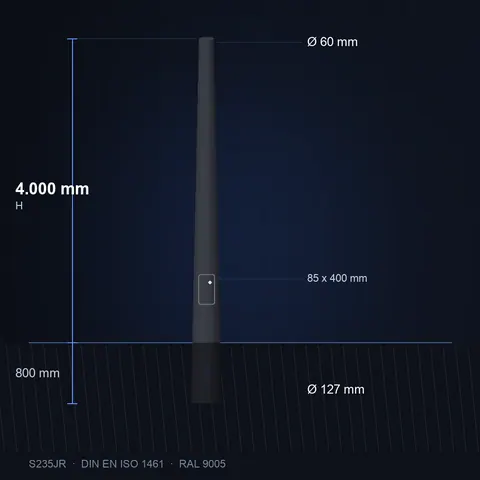 News
New: steel and aluminium lighting columns to the Dutch standard
Lichtplein now supplies conical steel lighting columns of 4 and 6 metres at a sharp price on request, plus aluminium columns of 3, 4 and 6 metres. With full dimensions on the product page, matching our street and post-top luminaires, delivered by truck.
8 October 2026 Knowledge
UFO or linear high bay: which one for your warehouse or hall
A high bay comes as a round UFO, as a linear luminaire above the racking aisle and as a flat panel with UGR<21. Which one you choose depends on mounting height, racking and the work done in the hall. This article gives the selection rules and a worked example for the number of luminaires.
8 October 2026