Worked example: car park with linear luminaires and sensors
A fictional two-level car park of 3,000 m², lit with 40 W linear luminaires with microwave sensor and night setting. This is how you arrive at the quantities, the lux level and the saving compared with lighting that burns continuously.
Starting points of the example
This worked example is fictional, but the dimensions come from practice. The car park sits beneath an office building and has two parking levels of 50 by 30 metres each: 1,500 m² per level, 3,000 m² in total and more than 120 parking bays. The clear height is 2.6 metres; ceiling and walls are grey concrete. One ramp of 6 by 10 metres forms the entrance and exit. The car park is open 24 hours a day, but it is only busy in the morning and evening peaks.
The requirements come from EN 12464-1:
- Lanes: 75 lux average, UGR no higher than 25.
- Parking bays: 75 lux average, uniformity at least 0.4.
- Entrance and exit by day: 300 lux, so that eyes coming in from outside can adapt.
- Entrance and exit at night: 75 lux.
Emergency lighting is left out here. More background on standards and IP ratings is in lighting car parks.
Luminaire choice: 40 W linear luminaire with microwave sensor
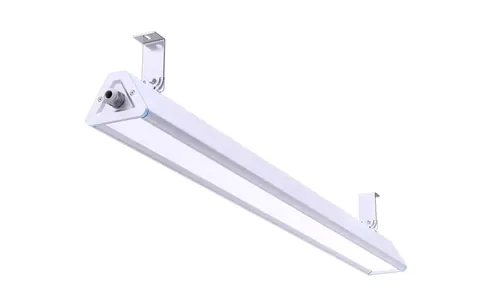
For the parking levels we choose the 40 W waterproof linear luminaire from the TRIVO range: 5,600 lm at 140 lm/W, IP65, 4000K, with built-in microwave sensor. The reasons:
- 40 W rather than 20 W: under a 2.6 metre ceiling, 2,800 lm only reaches 75 lux with a tight grid; 5,600 lm keeps the number of light points and the installation time limited.
- IP65: road salt, brine and condensation are normal in an unheated car park. IP69K is only needed where a pressure washer is used.
- Microwave rather than PIR: the sensor sees through the diffuser and detects a car approaching several metres away, so the light runs ahead of the car.
- Through-wired and tool-free: with more than a hundred luminaires, the installation time per unit decides your margin.
The eight luminaires on the entrance and exit are the same linear luminaire in the DALI-2 version (6,800 lm): no movement sensor is needed there, but a fixed day and night level via the time clock of the building installation is.
Quantities: how you arrive at the parts list
Rule of thumb for grey concrete and a low ceiling: one 5,600 lm linear luminaire per 25 to 30 m² of floor. For 3,000 m² that means 100 luminaires, 50 per level, in a grid of roughly 5 by 6 metres, along the edge of the lane so the light also falls in the bays.
Check with the lumen method per level: 50 luminaires × 5,600 lm = 280,000 lm. With a utilisation factor of 0.55 (dark concrete, low ceiling) and a maintenance factor of 0.8, 123,200 lm reaches the floor: 123,200 / 1,500 m² = 82 lux average, 7 lux of margin for the dark corners behind columns and under beams.
The 60 m² entrance and exit needs 300 lux. The DALI-2 version delivers 6,800 lm per luminaire: 8 × 6,800 lm × 0.5 × 0.8 = 21,760 lm, or more than 360 lux. The parts list:
- 100 linear luminaires 40 W IP65 with microwave sensor
- 8 linear luminaires 40 W IP65 with DALI-2
- 3 luminaires with sensor as spares on site
- 1 remote control for the sensor settings
- 3-core cable for the sensor rows, 5-core cable for the DALI-2 row
Sensor settings and night setting
You set the parameters per luminaire with the remote control, without opening the diffuser:
- Detection range: 75 percent, so a luminaire does not look across two rows of bays.
- Hold time at full light: 2 minutes on the lane, 4 minutes in the parking bays, so nobody loading their boot is left in the dark.
- Night setting: 10 percent, never fully off. Cameras stay usable and the car park feels safe.
- Standby time: unlimited; the luminaire stays at 10 percent until the next movement.
Because the microwave sensor sees a car coming and the luminaires hang 5 metres apart, a lane switches on segment by segment as the car drives. If a whole lane must go to full light at once, or a different level must apply at night than by day, choose the DALI-2 version with groups in the control system. The entrance and exit stays at 100 percent by day and drops to 25 percent at 22:00 via the time clock: more than 360 lux becomes around 90 lux, above the 75 lux the standard asks for at night.
Saving: continuous burning versus sensor control
A 40 W luminaire burning at full power for 8,760 hours a year uses 350 kWh. For the 100 luminaires on the parking levels that is 35,000 kWh a year; at an electricity price of 0.25 euro per kWh (assumption) that is 8,750 euro.
Suppose that by day, from 6:00 to 22:00, a luminaire burns at full power 25 percent of the time and sits in the 10 percent night setting 75 percent of the time: 13 W on average. At night that is 5 percent full and 95 percent night setting: 6 W on average. Per day 16 × 13 + 8 × 6 = 256 Wh, per year 93 kWh instead of 350 kWh: 73 percent less. For the 100 luminaires: 9,300 kWh and 2,325 euro a year, a saving of 25,700 kWh and more than 6,400 euro.
The 8 luminaires on the entrance and exit burn at full power by day and at 25 percent at night: 263 kWh each, 2,100 kWh together, against 2,800 kWh continuous. The whole car park thus ends up at around 11,400 kWh a year instead of 37,800 kWh. With a saving of 64 euro per luminaire per year, even the full purchase price of a linear luminaire from the TRIVO range, 46 to 129 euro excl. VAT, is recovered in about two years.
Installation and circuit layout
Through-wiring saves junction boxes: one supply per row of 10 luminaires, the cable running end to end through the luminaire. Spread the 108 luminaires over at least two circuits per level, so a tripped breaker never darkens a whole level. The 4.3 kW total is not the problem there, the inrush current of the drivers is; a C-curve breaker tolerates that peak better than a B-curve. Set the sensors row by row straight from the access platform, before closing the diffusers.
Frequently asked questions
Why 40 W and not 20 W or 60 W?
Under 2.6 metres, 40 W with 5,600 lm reaches 75 lux with a 5 by 6 metre grid. With 20 W (2,800 lm) you need twice as many light points; 60 W only makes sense with higher ceilings or wider grids.
Can the night setting be 0 percent?
Technically yes, but a dark car park feels unsafe and cameras see nothing. Keep 10 to 20 percent.
Do these quantities also apply to my car park?
Only if ceiling height, reflectances and layout are comparable. Light walls and a white ceiling reduce the number; beams and a higher ceiling increase it. A lighting calculation gives certainty per zone.
Can I change the sensor settings later?
Yes, with the remote control for the sensor settings you adjust range, hold time and night setting without opening the luminaire.
What is the lead time for 108 luminaires?
We supply linear luminaires from European stock within 5 working days; from 100 units a project price applies.
Would you like this worked example translated to your own car park? Have a lighting calculation made for 350 euro excl. VAT, or request a quotation straight away for the linear luminaires from the TRIVO range; Lichtplein supplies businesses only.
Read also
 Worked examples
Worked example: a 4,000 m² warehouse from fluorescent to LED high bay
A fictional hall of 80 by 50 metres, 10 metres high, 200 lux required. Step by step we work out how many 150 W UFO high bays are needed, what that saves per year in kWh compared with fluorescent, and what sensors add on top.
8 October 2026 Knowledge
3000K, 4000K or 5000K: choosing colour temperature by application
Kelvin decides whether light looks warm, neutral or cool, and with it whether a street feels comfortable and a warehouse works well. We set out the right colour temperature for each application.
7 October 2026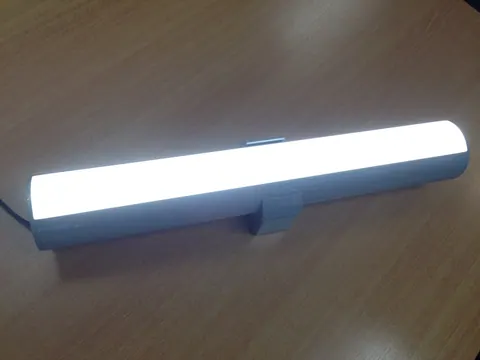 Knowledge
IP and IK ratings explained: IP65, IP66, IP67, IP69K, IK08 and IK10
The IP rating tells you how well a luminaire resists dust and water, the IK rating how much impact energy the housing can take. Read what the figures mean, which rating you need in which environment and which series from our range fit the job.
6 October 2026 Worked examples
Worked example: car park with 12 columns of 6 metres
A fictional car park of 100 by 60 metres needs 20 lux from twelve steel lighting columns of 6 metres. We work out step by step how much light is required, which VIA street luminaires fit and what the complete bill of materials costs, indicatively.
6 October 2026