Rust at the column base: causes and prevention
Rust on a lighting column almost always starts just above ground level. Why there, how to prevent it on new columns and what to do with columns that are already affected.
Why rust almost always starts at ground level
A lighting column that is still crisp grey or black higher up the shaft may already show brown streaks, blisters in the coating or loose flakes at the base. The zone from roughly 30 cm below to 30 cm above ground level is the most heavily loaded part of any steel column: the steel is alternately wet and dry, sits without oxygen below ground and with plenty of oxygen above it, and salt, soil and mechanical damage all come together there.
That difference in oxygen supply works like a battery. The part just below ground level becomes the anode and dissolves, the part above it the cathode. Zinc that lasts for decades higher up the column can disappear many times faster in the ground-level zone. Once the zinc is gone, the steel rusts from the outside in and the column loses wall thickness exactly where the bending moment from wind is greatest.
Cause 1: de-icing salt, moisture and poor drainage
Along gritting routes, brine splashes against the column base and salt stays behind in the soil. Chlorides sharply accelerate the corrosion of zinc and steel, and salt also attracts moisture, so the base stays damp even in dry weather. The same applies to columns standing in a gutter, in a dip or in paving where rainwater cannot drain away.
The backfill matters too. Rubble and building waste hold water and often contain cement or lime residues; coarse sand lets water drain.
Cause 2: a damaged zinc layer
Hot-dip galvanising to EN ISO 1461 gives a zinc layer that is alloyed with the steel and does not peel; the minimum coating thickness depends on the wall thickness of the steel. Small scratches are not a problem: the surrounding zinc protects the exposed steel cathodically. Larger damage is. Think of a strimmer hitting the same spot every season, lifting chains during unloading, the excavator during erection, or a drilled hole for an extra cable entry that was never touched up.
On a powder-coated (duplex) column you first see damage as a grey patch: the paint is gone, the zinc is still doing its job. Do not leave it. Moisture creeps under the loose paint edge and the zinc layer wears faster at that spot than elsewhere.
Prevention on new columns: heat-shrink sleeve and installation
The standard solution is a thick-walled heat-shrink sleeve with an adhesive lining. You slide it over the column base before erection and shrink it with a gas torch, from the buried section to around 30 cm above ground level. The sleeve seals out salt and moisture and absorbs the knocks from the strimmer. After erection, check that the sleeve is not torn anywhere.
Beyond that: backfill with sand, make sure water can drain away from the base, do not lock the column into concrete or paving without a draining joint, and close the access door properly so the inside stays dry too. We supply the TURRIS steel lighting columns of 4 and 6 metres hot-dip galvanised or additionally powder-coated in RAL 9005, matching the VIA street luminaires and the POLARIS post-top luminaires. With the NEXUS column cut-out in the access door, the connection stays protected as well.
Alternative: an aluminium column
Aluminium forms its own oxide skin, which repairs itself after a scratch. There is no zinc layer to run out, so the ground-level zone is far less critical on aluminium. Along gritting routes, on the coast and in places where touching up is awkward, that is a strong argument for the CIVIS aluminium lighting columns of 4 and 6 metres, supplied on a project basis with price on request.
Do watch out for galvanic corrosion: aluminium should not sit directly against concrete, steel or galvanised anchors. Use an insulating layer or a column shoe and stainless steel fixings.
Inspection and repair of existing columns
Walk your columns at least once a year, preferably in spring after the gritting season. Look for brown deposits, blisters and flakes in the bottom 50 cm, for pitting in the steel and at the access door. If in doubt about the wall thickness, measure it ultrasonically or have the column assessed; a column with a rusted-through base is a safety risk in a storm and must be replaced.
Surface rust can be repaired: wire-brush or sand back to bright metal, degrease, apply a zinc-rich primer or cold galvanising paint and, on duplex columns, put the colour back over it. Then protect the repaired zone anyway, for instance with a wrap-around sleeve or bandage system, because a closed heat-shrink sleeve will no longer fit over a standing column.
Frequently asked questions
Can I fit a heat-shrink sleeve to a column that is already standing?
Not a closed sleeve; that has to go over the column before erection. For existing columns there are wrap-around sleeves and bandage systems that you fit after cleaning and touching up.
Is a powder-coated column better protected at the base than a plain galvanised one?
Yes, the duplex system lasts longer and damage shows as a grey patch rather than rust. A powder-coated column should still get a heat-shrink sleeve at the base, though.
How do I tell whether a rusty column is still safe?
Surface rust spots without pitting can be repaired. With pitting, loose flakes or holes in the bottom zone, have the wall thickness measured and replace the column if in doubt.
Is aluminium always the better choice?
On the coast and along gritting routes, usually yes. Inland, well-galvanised steel with a heat-shrink sleeve comes close, at a lower unit price.
View the TURRIS steel lighting columns at a sharp price on request or the CIVIS aluminium columns on a project basis, or request a quotation straight away. Lichtplein supplies businesses only.
Read also
 Knowledge
LED lighting before year end: KIA, EIA and planning for Dutch businesses
Many companies replace their lighting in the last months of the year. What the Dutch small-scale investment allowance (KIA) and energy investment allowance (EIA) can mean, what to watch out for and how to have the luminaires on site in time.
28 October 2026 Knowledge
Site lighting for the dark months: checklist for business sites and car parks
Once the clocks go back it is dark by half past four, and the first and last hour of the working day happen in the dark. How to check your outdoor lighting now, fill the gaps and have the luminaires on site before the shortest days.
25 October 2026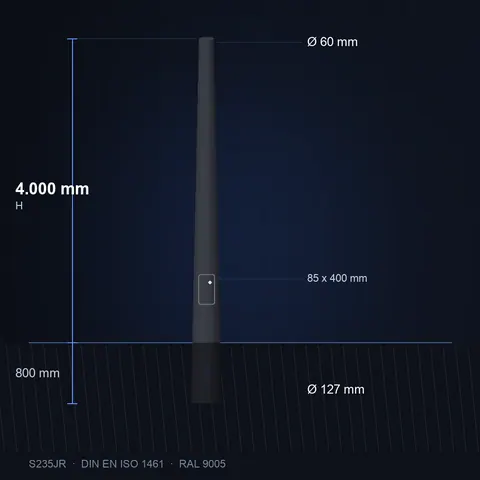 News
New: steel and aluminium lighting columns to the Dutch standard
Lichtplein now supplies conical steel lighting columns of 4 and 6 metres at a sharp price on request, plus aluminium columns of 3, 4 and 6 metres. With full dimensions on the product page, matching our street and post-top luminaires, delivered by truck.
8 October 2026 Troubleshooting
LED flickering or blinking: causes and solutions
A flickering LED luminaire can almost always be traced back to the driver, the dimmer or the installation. Here is how to find the cause in a few steps, and when a repair pays off versus a replacement.
7 October 2026