Floodlights for yards and façades: wattage, optics and mounting
Which wattage goes with which mounting height, when do you choose an asymmetric optic, and how do you keep the light off the neighbours and off the water? A practical selection guide for installers.
Three power classes, three applications
The FLUX series runs from 30 W to 1,500 W, in three classes each with its own mounting height:
- 30 to 50 W, compact: roughly 4,000 to 7,000 lm. Façades, entrances, bicycle shelters and small car parks, at 3 to 5 metres, often with a plug-in sensor.
- 100 to 400 W, area: 15,000 to over 60,000 lm. Car parks, loading bays, storage yards and construction sites, on columns of 6 to 12 metres.
- 500 to 1,500 W, modular: 85,000 to over 200,000 lm, built with CREE LEDs. Ports, container terminals and stadiums, on masts of 15 to 30 metres.
Which class you need follows from the required illuminance. The standard for outdoor workplaces (EN 12464-2) gives guide values per task; as an indication, check the current standard for your situation: car parks 5 to 20 lux depending on traffic, storage yards around 20 lux, loading and unloading areas around 50 lux and assembly work on a construction site around 100 lux. As a rule of thumb, roughly half of the luminous flux actually lands on the area: 1,000 m² at 20 lux therefore needs around 40,000 lm installed.
Symmetric or asymmetric
The optic determines more than the wattage how the light lands on the area. A symmetric optic of 30°, 60° or 120° spreads the light evenly around the axis of the floodlight and suits mounting from a tall column straight above or in the middle of the area to be lit.
An asymmetric optic throws the light to one side while the glass stays almost horizontal. You mount the floodlight at 0 to 10 degrees of tilt at the edge of the area and still light it far forward, while hardly any light goes upward or sideways. Next to housing, water and façades it is the first choice.
FLUX offers both: compact floodlights with a wide 120° beam for low mounting, and area and stadium floodlights with narrower optics, such as 30°. Whether an asymmetric optic is available for your application you can see in the item specifications or ask via contact.
Mounting height and beam angle belong together
The diameter of the light patch on the ground is roughly twice the mounting height times the tangent of half the beam angle. Three recognisable situations:
- 120° at 5 metres: a patch of about 17 metres. Façade, entrance or small car park with a single compact floodlight.
- 60° at 10 metres: a patch of about 11.5 metres, with far more light per square metre. Area floodlight on an 8 to 10 metre column.
- 30° at 20 metres: a patch of about 10.7 metres, to hit a quay or loading zone precisely from a high mast.
Rule of thumb: the lower the column, the wider the optic; the taller the mast, the narrower. A wide optic up high wastes light beyond the boundary, a narrow optic down low gives bright spots with dark gaps. For façades and small yards, the steel columns of 4 and 6 metres from the TURRIS series fit, from stock at a sharp price on request, answer within 48 hours. Taller masts are project work: request them together with the luminaires via a quotation.
Light nuisance: shield, tilt angle and colour
A floodlight aimed too high lights the neighbourhood instead of the yard. The Dutch guideline on obtrusive light divides the surroundings into zones E1 to E4 and limits the vertical illuminance on the façade of a dwelling, with a stricter limit during the night hours. As an indication: rural areas (E2) around 5 lux and 1 lux at night, urban areas (E3) around 10 and 2 lux; consult the current guideline for the exact values and the applicable night hours. Three measures:
- Asymmetric optic mounted flat: 0 to 10 degrees of tilt, so nothing radiates above the horizon.
- Shield: a visor or louvre cuts off the light towards housing, road or water without loss of output; check the series accessories for the shield that fits your floodlight.
- Symmetric optic tilted no more than 20 to 25 degrees: any steeper and a driver or neighbour looks straight into the LED.
Colour temperature matters too: residents experience warm white of 2700 or 3000 K as less intrusive and it spares nocturnal wildlife, so near housing it is the sensible choice. 4000 K is the standard for working areas, and you choose 5000 K where contrast and camera images come first, such as in ports and on construction sites.
Sensors and dimming
A 30 to 50 W façade floodlight does not need to burn all night. The compact FLUX models are sensor-ready: a plug-in microwave sensor with daylight sensor switches the floodlight on only on movement in the dark.
On larger areas you would rather dim than switch. Some of the larger FLUX floodlights are 1-10V dimmable, for example the 750 W high-output models; check this per item in the specifications. Linked to a time switch or motion detection, the yard runs at 30 to 50 percent outside working hours and jumps to full output when there is activity. On a yard lit from 18:00 to 07:00 that can save a large share of the energy consumption and helps keep light nuisance within the guideline during the night hours.
Construction sites and ports
On a construction site the floodlight hangs from scaffolding, a mobile mast or a container and moves between phases. Choose IK10 and IP66, a sturdy bracket with a degree scale so the angle is quickly right again after moving, and a cable gland with strain relief. As a rough indication: for 50 lux on a 50 by 50 metre site, four floodlights of 300 to 400 W on 8 metre mobile masts get you a long way; check it with a lighting calculation.
Ports and quays ask for corrosion resistance and direction. Salt air attacks housings and fixings: pay attention to the coating, use stainless steel fixings and avoid contact between different metals. Never aim the light at the water, a dazzled skipper is a safety risk; an asymmetric optic or a shield on the water side solves that. On port masts of 15 to 30 metres you work with the modular FLUX floodlights of 500 to 1,500 W, 30° optic, in 5000 K for sharp contrast between containers and vehicles.
On a column the connection belongs in a column fuse box with a fuse behind the door, preferably with surge protection: cheaper than replacing a driver at 20 metres after a night of thunderstorms.
Frequently asked questions
How many watts do I need for a 1,000 m² car park?
Work with 10 to 20 lux (guide values from EN 12464-2, depending on traffic). At 20 lux you need roughly 40,000 lm installed, so two floodlights of about 150 W on 8 metre columns. A lighting calculation gives the exact number and the uniformity.
When do I choose an asymmetric optic?
When the floodlight stands at the edge of the area and you want to prevent light nuisance to neighbours, road or water. You mount it almost horizontally and the area is still lit far forward.
Does a microwave sensor also work in winter?
Yes. Unlike infrared, microwave does not react to temperature difference but to movement, so it works in frost as well. The daylight sensor keeps the floodlight off during the day.
How far may I tilt a floodlight?
An asymmetric optic 0 to 10 degrees, a symmetric optic at most 20 to 25 degrees above horizontal. Steeper gives glare and spill above the horizon; use a taller column or a shield instead.
What does a floodlight cost?
The FLUX series runs from 19 to 1,315 euros excluding VAT, from accessories to the modular 1,500 W stadium floodlight. Project prices apply from 100 units; Lichtplein supplies businesses only.
See all floodlights from 30 to 1,500 W in the FLUX series or have your site calculated with a lighting calculation.
Read also
 Knowledge
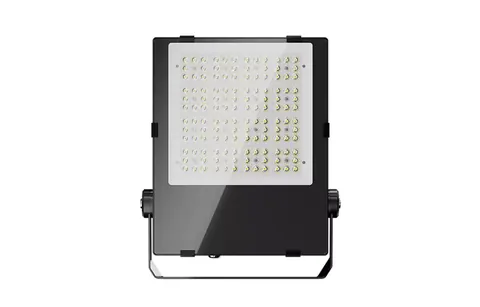
LED lighting before year end: KIA, EIA and planning for Dutch businesses
Many companies replace their lighting in the last months of the year. What the Dutch small-scale investment allowance (KIA) and energy investment allowance (EIA) can mean, what to watch out for and how to have the luminaires on site in time.
28 October 2026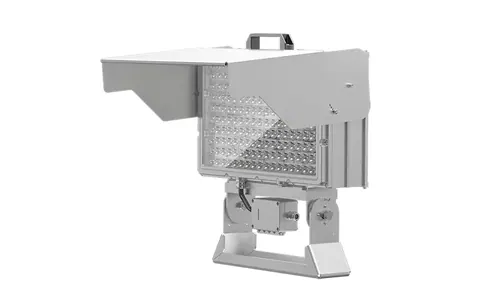 Knowledge
Site lighting for the dark months: checklist for business sites and car parks
Once the clocks go back it is dark by half past four, and the first and last hour of the working day happen in the dark. How to check your outdoor lighting now, fill the gaps and have the luminaires on site before the shortest days.
25 October 2026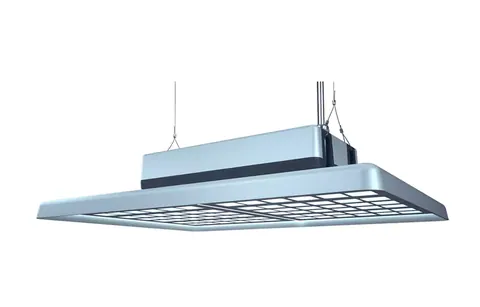 Knowledge
UFO or linear high bay: which one for your warehouse or hall
A high bay comes as a round UFO, as a linear luminaire above the racking aisle and as a flat panel with UGR<21. Which one you choose depends on mounting height, racking and the work done in the hall. This article gives the selection rules and a worked example for the number of luminaires.
8 October 2026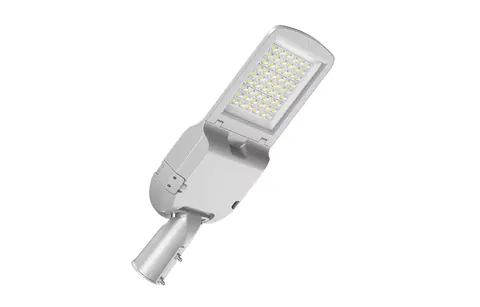 Knowledge
3000K, 4000K or 5000K: choosing colour temperature by application
Kelvin decides whether light looks warm, neutral or cool, and with it whether a street feels comfortable and a warehouse works well. We set out the right colour temperature for each application.
7 October 2026