Charging from the lighting column: how a charging lamp post works
A charging lamp post combines public lighting with two EV charge points in a single aluminium column. We explain how the CityCharger works, what OCPP and load balancing do and where the column fits best.
What a charging lamp post is
A charging lamp post is a lighting column with two charge points for electric cars built into its base. The luminaire at the top lights the street or car park like any other column; low on the column, at operating height, sit two Type 2 charging sockets that the user unlocks with a charge card or app. One column position serves two purposes, and no separate charging post is needed next to the column.
At Lichtplein the CIVIS series supplies the CityCharger charging lamp post with 2x 11 kW. The column is aluminium and is made to order per project, with a mounting height of 4 to 8 metres. Pricing is on request, because height, luminaire, colour and the grid connection differ from project to project.
How the CityCharger is built
The column is double-walled and insulated. The charging electronics sit in the insulated inner compartment, separated from the lighting cable. Lighting and charging are separate circuits with their own protection, so a fault in the charging section need not affect the street lighting.
- Charging power: two charge points of 11 kW each (three-phase, 16 A). An average electric car with a three-phase on-board charger adds roughly 50 to 60 kilometres of range per hour, depending on the car's consumption.
- Protection rating: IP54 and impact rating IK10, resistant to knocks, vandalism and light collisions with a trolley or bicycle.
- Communication: OCPP 1.6 (JSON) over LAN or GSM, plus RS485, for example for linking a kWh meter for load balancing.
- Luminaire: the top takes a VIA street luminaire or a POLARIS post-top luminaire, depending on the streetscape you want. The column top is matched to the chosen luminaire per project.
- Warranty: 2 years on the charging lamp post, including the charging electronics.
Why municipalities choose the charging lamp post
The main argument is space. A stand-alone charging post is an extra object on the pavement: it takes up walking space, can draw objections from residents and needs its own foundation and connection. A charging lamp post replaces an existing column at a position that is already in the lighting plan. The number of objects in the street stays the same and the streetscape stays calm.
That also simplifies the procedure. A lighting column on an existing position is usually a simpler process than a new object at a new location: the ground conditions are known, the cable route is known and there is less reason for objection. Note that designating parking bays as charging bays generally still requires a separate traffic order. The highway authority arranges that independently of the column itself.
The same advantages apply to site managers of businesses, hotels and car parks: no extra posts on a crowded car park, one supplier for light and charging and one installation visit.
OCPP and load balancing
OCPP (Open Charge Point Protocol) is the open standard through which a charge point talks to a management platform. The CityCharger supports OCPP 1.6 in the JSON variant, a version that is widely supported by charge point operators. That leaves you free to choose your operator: starting and stopping with a card or app, settling charging sessions, fault reports and software updates all run through that platform, not through us.
Load balancing distributes the available power across the charge points. Static means you set a ceiling, for example 22 kW for the whole column. Dynamic means a kWh meter at the connection measures over RS485 what is still available and the column adjusts the charging power accordingly. With two cars connected, each gets 11 kW; if the connection is tight, the column throttles back without tripping the fuse. This lets you place several charging lamp posts on a single grid connection.
Power supply: not on the lighting cable
A common assumption is that the charging lamp post simply runs on the public lighting cable. It cannot. The lighting network is sized for a few amps per column and in many municipalities is switched, so it is not energised during the day. Two 11 kW charge points together draw 22 kW, which is around 32 A per phase. That generally requires a dedicated three-phase connection from the grid operator, just as for a conventional charging post.
In practice the arrangement looks like this: the grid operator brings a connection to the column base, the charging section gets its own connection compartment in the column, and the lighting stays on the existing lighting network via a NEXUS column connection box. Allow for the lead time of the grid connection in your planning; it is often longer than the delivery time of the column.
Where the charging lamp post fits
- Residential streets with parallel parking: the column stands at the head of two parking bays and the charging cable reaches both cars.
- Business and hotel car parks: lighting and charging in one row of columns, without extra posts in the walking routes.
- Park and ride and municipal car parks: many charge points on a limited area, with load balancing on one connection.
- New housing developments: the charging infrastructure goes in with the lighting plan, instead of being added later.
The charging lamp post is less suitable where the column stands far from the parking bays, such as on a wide pavement or in a verge, or where the mounting height exceeds 8 metres. There you are better off combining a separate CIVIS or TURRIS column with a stand-alone charging facility.
If you want to know whether the positions in your lighting plan are suitable, we calculate it in a lighting design: column spacing, mounting height and luminaire choice in one report, for 350 euros excl. VAT.
Frequently asked questions
Can I convert an existing column into a charging lamp post?
Generally not. The CityCharger is a complete column with an insulated inner compartment and its own connection space. You replace the existing column at the same position; whether the existing luminaire can be reused depends on the column top and is assessed per project.
Which charge card works on the charging lamp post?
Your charge point operator determines that via OCPP. In practice the platform accepts the common charge cards and apps; the column itself imposes no restrictions.
How many charging lamp posts can share one grid connection?
That depends on the capacity of the connection and whether you use dynamic load balancing. With a kWh meter on RS485 the column distributes the power, so you can install more charge points than the peak power would otherwise allow. We coordinate this with you per project.
What is the delivery time for the CityCharger?
The CityCharger is made to order per project. As a guideline, our column lead time of 3 to 6 weeks applies; we confirm the exact delivery time in the quotation. Apply for the grid connection in parallel, as that often determines the overall timeline.
Does Lichtplein also sell to private individuals or owners' associations?
Lichtplein supplies businesses, municipalities and installers only. An owners' association orders through its installer or property manager.
Request a project price for the CityCharger charging lamp post via our quotation page, or first browse the complete CIVIS series with aluminium columns and solar lighting columns.
Read also
 Knowledge
LED lighting before year end: KIA, EIA and planning for Dutch businesses
Many companies replace their lighting in the last months of the year. What the Dutch small-scale investment allowance (KIA) and energy investment allowance (EIA) can mean, what to watch out for and how to have the luminaires on site in time.
28 October 2026 Knowledge
Site lighting for the dark months: checklist for business sites and car parks
Once the clocks go back it is dark by half past four, and the first and last hour of the working day happen in the dark. How to check your outdoor lighting now, fill the gaps and have the luminaires on site before the shortest days.
25 October 2026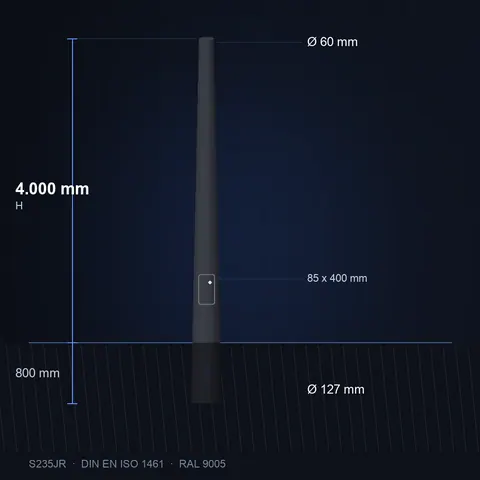 News
New: steel and aluminium lighting columns to the Dutch standard
Lichtplein now supplies conical steel lighting columns of 4 and 6 metres at a sharp price on request, plus aluminium columns of 3, 4 and 6 metres. With full dimensions on the product page, matching our street and post-top luminaires, delivered by truck.
8 October 2026 Knowledge
UFO or linear high bay: which one for your warehouse or hall
A high bay comes as a round UFO, as a linear luminaire above the racking aisle and as a flat panel with UGR<21. Which one you choose depends on mounting height, racking and the work done in the hall. This article gives the selection rules and a worked example for the number of luminaires.
8 October 2026