Steel or aluminium lighting column: the differences
Steel or aluminium for your lighting columns? We compare weight, price, corrosion, maintenance, impact behaviour, recycling and lead time, so you can pick the right column for each project.
In brief
A 4 or 6 metre lighting column is typically bought for twenty to forty years. Choosing between steel and aluminium determines what the column weighs, what it costs, how it ages and how it behaves when a vehicle hits it. Lichtplein offers both: the steel TURRIS columns at a sharp price on request, and the aluminium CIVIS columns on a project basis.
- Steel: heavier, lower unit price, hot-dip galvanised, stiff and robust.
- Aluminium: roughly half the weight, higher unit price, virtually maintenance free, usable as a passively safe column in a tested version.
- Both: Dutch standard with access door, CE marked on the basis of the European column standard EN 40, matching our NEXUS column fuse boxes and VIA street luminaires.
Weight and installation
Steel has a density of about 7.85 kg/dm³, aluminium 2.7 kg/dm³. Aluminium is less stiff, however (its modulus of elasticity is roughly a third of that of steel), so an aluminium column gets a thicker wall or a larger diameter. The net result is that an aluminium column weighs not a third, but about half of a comparable steel column.
In practice this means two fitters can usually erect a 4 metre aluminium column without a crane. A 6 metre steel column complete with luminaire soon calls for a crane lorry or a column erector. On a site without access for heavy plant, or on a project with dozens of columns, that saves hours a day.
Price and lead time
Steel is cheaper per kilo than aluminium and the production of conical columns is highly standardised. That is why the steel TURRIS columns are sharply priced: price on request, answer within 48 hours, depending on height (4 or 6 metres) and finish (hot-dip galvanised or additionally powder coated in RAL 9005). You add them to your quotation request in the quantity you need, even as a single unit.
The aluminium CIVIS columns of 3, 4 and 6 metres are supplied on a project basis with price on request, answer within 48 hours. Expect a higher unit price than steel, part of which you recover through lower installation costs and the absence of maintenance. Lighting columns have a lead time of 3 to 6 weeks. TURRIS columns come from stock and sit at the short end of that range; aluminium columns are made per project, so plan them early. From 20 columns we quote a project price, for steel as well as aluminium.
Corrosion and maintenance
A steel column is protected by zinc. Hot-dip galvanising to EN ISO 1461 usually gives decades of protection in a rural or urban environment. An additional powder coating on top of the zinc (duplex system) extends that period and adds colour, on TURRIS in RAL 9005 black. The weak point is the ground line, where moisture, de-icing salt and soil meet. An extra coating at the soil-to-air transition is standard good practice there.
Aluminium forms its own oxide layer and needs no coating. That makes the column virtually maintenance free, including on the coast where zinc wears faster. Do take care with direct contact with concrete or other metals: an insulating layer or a column base sleeve belongs in between, otherwise galvanic corrosion occurs.
Over 25 years aluminium usually wins on maintenance cost: no touching up of zinc damage, no repainting. Well galvanised steel at an inland location comes close in practice.
Impact behaviour and safety
Along roads where a collision is possible, the behaviour of the column on impact counts. EN 12767 classifies columns by passive safety: energy absorbing (classes HE and LE) or non energy absorbing (class NE). A standard steel column is stiff and strong and is usually not tested as energy absorbing: on impact the column generally stays up and the damage is in the vehicle. That is fine behind a crash barrier, on a car park or in a residential street at 30 km/h.
Aluminium columns are lighter and can be designed to break or deform in a controlled way on impact. Passively safe columns on the verge of 50 and 80 km/h roads without a crash barrier are therefore often made of aluminium. Not every aluminium column has been tested for this: for such an application always ask for the tested class to EN 12767, which must match the requirements of the road authority.
Recycling and residual value
Both materials are fully recyclable and are in fact recycled. The difference lies in energy: remelting aluminium takes only a fraction of the energy needed for primary production. A written-off aluminium column therefore has a high scrap value. Steel is also easy to recycle, but the zinc layer has to be dealt with in the process and the residual value per column is lower. If a tender scores on carbon or environmental cost, take this into account.
Which column when
- Choose steel (TURRIS) for business parks, car parks, residential streets and cycle paths where a sharp price, short lead time and a robust column count. Also when you add or replace one or a few columns.
- Choose aluminium (CIVIS) for coastal sites, passively safe applications along roads (in a version tested to EN 12767), sites without crane access and projects where zero maintenance and residual value weigh heavily. Also when you want a CityCharger charging lantern or a solar lighting column in the same street scene.
Both columns have an access door to the Dutch standard. The NEXUS column fuse box fits inside, and on the column top you mount a VIA street luminaire (60 mm) or a POLARIS post-top luminaire (60 to 80 mm) directly. Unsure about column height or spacing? Have a lighting calculation made for 350 euro excl. VAT.
Frequently asked questions
How much lighter is an aluminium column than a steel one?
Roughly half. Aluminium weighs 2.7 kg/dm³ against 7.85 kg/dm³ for steel, but the wall of an aluminium column is thicker to achieve the same stiffness.
Is a galvanised steel column suitable on the coast?
Yes, but the zinc layer wears faster there because of salt in the air. In that case choose a duplex system (galvanised plus powder coating) or an aluminium column.
Does the same luminaire fit a steel and an aluminium column?
Yes. Both follow the Dutch standard: VIA street luminaires fit 60 mm, POLARIS post-top luminaires 60 to 80 mm, and the NEXUS column fuse box fits in the access door.
What does an aluminium lighting column cost?
The aluminium columns of 3, 4 and 6 metres are priced on request, answer within 48 hours: send your quantities, heights and required finish via the quotation page. From 20 columns we quote a project price.
View the steel TURRIS columns at a sharp price on request, or request a quotation for aluminium CIVIS columns on a project basis. Lichtplein supplies businesses only.
Read also
 Knowledge
LED lighting before year end: KIA, EIA and planning for Dutch businesses
Many companies replace their lighting in the last months of the year. What the Dutch small-scale investment allowance (KIA) and energy investment allowance (EIA) can mean, what to watch out for and how to have the luminaires on site in time.
28 October 2026 Knowledge
Site lighting for the dark months: checklist for business sites and car parks
Once the clocks go back it is dark by half past four, and the first and last hour of the working day happen in the dark. How to check your outdoor lighting now, fill the gaps and have the luminaires on site before the shortest days.
25 October 2026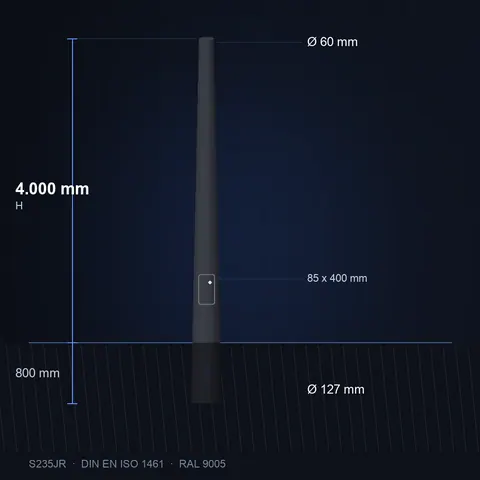 News
New: steel and aluminium lighting columns to the Dutch standard
Lichtplein now supplies conical steel lighting columns of 4 and 6 metres at a sharp price on request, plus aluminium columns of 3, 4 and 6 metres. With full dimensions on the product page, matching our street and post-top luminaires, delivered by truck.
8 October 2026 Knowledge
UFO or linear high bay: which one for your warehouse or hall
A high bay comes as a round UFO, as a linear luminaire above the racking aisle and as a flat panel with UGR<21. Which one you choose depends on mounting height, racking and the work done in the hall. This article gives the selection rules and a worked example for the number of luminaires.
8 October 2026