Hot-dip galvanised or powder coated: the finish on lighting columns
A steel lighting column stands outdoors for decades, and its finish decides whether it gets there without rust. What hot-dip galvanising to EN ISO 1461 does, when a duplex system with RAL 9005 powder coating justifies the extra cost, and how you protect the ground-line zone.
Why the finish decides the service life
A steel lighting column is bought for 25 to 30 years. In that time it has to cope with rain, de-icing salt, dog urine and strimmers. Untreated steel rusts outdoors within a short time, so corrosion protection is not a detail but the heart of the specification.
There are two standard choices: hot-dip galvanising alone, or galvanising with a powder coating on top, the duplex system. We supply the TURRIS steel lighting columns of 4 and 6 metres in both versions: plain galvanised, or galvanised and powder coated in RAL 9005 jet black. Both are made of S235JR steel, conical, to the Dutch standard and with the spigot size that takes the VIA street luminaires and the POLARIS post-top luminaires.
Hot-dip galvanising to EN ISO 1461
In hot-dip galvanising the complete column is degreased, pickled, fluxed and then immersed in molten zinc at around 450 °C. The zinc reacts with the steel to form zinc-iron alloy layers with a layer of pure zinc on top. It is not a coating lying on the surface but a layer bonded into it: it does not flake or peel. The inside of the tube is galvanised as well.
EN ISO 1461 links the minimum coating thickness to the steel thickness. For plate thicknesses of 3 to 6 mm, typical for lighting columns, the mean coating thickness must be at least 70 microns; from 6 mm upwards it is 85 microns. Zinc also acts as a sacrificial metal: where a scratch reaches the steel, the surrounding zinc keeps protecting it cathodically, so damage does not creep under the layer.
How long the zinc lasts depends on the environment. In an urban or lightly industrial atmosphere (corrosivity category C3) zinc loses 0.7 to 2.1 microns a year on average, and less in rural surroundings. A 70 micron layer therefore generally lasts more than 30 years without maintenance. A new column is shiny, after a year it is matt light grey; white spots (white rust) after damp storage are cosmetic.
Duplex: powder coating on top of the zinc
Powder coating straight onto bare steel is not an option outdoors: at the first chip the layer rusts loose from underneath. With duplex the galvanised column is first pre-treated (sweep blasted or chemically converted) so the powder bonds, and then given a polyester powder layer of typically 60 to 80 microns, cured at 180 to 200 °C. A good coater preheats the column so that outgassing from the zinc layer does not cause pinholes in the finish.
The combination protects for longer than the two layers would separately: the coating shields the zinc and the zinc prevents under-rusting beneath the coating. For duplex a factor of 1.5 to 2.5 compared with the added service lives is quoted. If the coating is damaged you see a grey spot, but no rust: the zinc simply carries on working under the paint.
For the TURRIS we use RAL 9005, jet black: a widely used colour for street furniture, matching fencing, cycle stands, litter bins and charging points, which are almost always black or anthracite.
Colour in the streetscape
Plain galvanised is the logical choice on business parks, car parks, along access roads and at sports grounds: functional, maintenance free and, after a year, an unobtrusive grey.
Black is the choice where the column is part of the design: residential streets, village centres, shopping areas, squares, parks and the grounds around offices and hotels. A black column looks slimmer, stands out less against a dark background and forms one whole with a black POLARIS post-top or VIA street luminaire. Many municipalities prescribe a fixed colour in a public realm design guide; check it before you quote, because the wrong colour is difficult to put right afterwards.
Keep column, luminaire and accessories in the same colour; a galvanised column with a black luminaire reads as careless. If you want a RAL colour other than 9005 for a larger project, discuss it beforehand via the contact page.
Extra cost and lead time
The TURRIS columns come at a sharp price on request, answer within 48 hours; the powder coated versions cost more per unit than the galvanised-only ones. The extra cost for the coating applies per column, so on a street with 20 columns it is a visible item on the quotation. Project pricing applies from 20 columns, the lead time is 3 to 6 weeks; for a non-standard RAL colour (on request) allow for a longer turnaround.
Weigh the extra cost against the service life. A galvanised column costs nothing further after installation. A powder coated column needs an annual inspection and occasional touching up, which over 25 years is a cost item as well. On a business park galvanised is therefore usually the logical choice; in a village centre or residential area the extra cost of black is quickly justified, certainly where the municipality prescribes the colour. Lichtplein supplies businesses only; for several columns simply request a quotation.
Maintenance and the ground-line zone
Galvanised columns need no maintenance. Do not paint over them without pre-treatment, because ordinary paint bonds poorly to zinc. Rinse powder coated columns once a year, especially along gritting routes, and touch up damage from stones, locks and strimmers within the season using a repair paint for galvanised steel. Remove stickers and graffiti with a mild agent, never with a wire brush.
The most vulnerable part of any column is the ground-line zone: roughly 30 cm below to 30 cm above ground level. Here moisture and oxygen alternate constantly, de-icing salt accumulates and the strimmer hits the column. In this zone zinc disappears noticeably faster than higher up the column.
Protect that zone with a heat-shrink sleeve: a thick-walled sleeve with an adhesive lining that you slide over the column base before installation and shrink with a torch, from the buried section to about 30 cm above ground level. Check during setting that the sleeve is undamaged, backfill the hole with sand rather than rubble and make sure water can drain away from the base. Fit the NEXUS column cut-out in the door opening and close the door properly, so the inside stays dry too.
Frequently asked questions
Can I have a galvanised column powder coated later?
In a workshop, yes, with the right pre-treatment. A column that is already installed can only be wet painted on site with a bonding primer for zinc; it looks tidy but does not match the life of factory duplex. If in doubt, order the powder coated version straight away.
Does a powder coated column rust when the paint is chipped?
No. Beneath the coating sits the zinc layer, which keeps protecting the steel. You see a grey spot, not rust. Touch up the spot to restore the appearance and the barrier.
Is a heat-shrink sleeve also needed on a powder coated column?
Yes. The ground-line zone stresses both finishes the hardest. The sleeve protects the coating against the strimmer and the zinc against moisture and salt. Fit the sleeve before the column goes into the ground.
How do I recognise a properly galvanised column?
An even, closed zinc layer with no bare patches or heavy zinc runs at the welds and the door opening. With a magnetic coating thickness gauge you can check at a few points that the layer meets the minimum values in EN ISO 1461: a mean of 70 microns at a wall thickness of 3 to 6 mm.
Which luminaires fit the TURRIS?
The TURRIS has the Dutch standard spigot. It takes the VIA street luminaires (column 60 mm) and the POLARIS post-top luminaires (60 to 80 mm). Choose luminaire and column in the same colour.
View the TURRIS steel lighting columns in both finishes, or request a project quotation straight away for 20 columns or more.
Read also
 Knowledge
LED lighting before year end: KIA, EIA and planning for Dutch businesses
Many companies replace their lighting in the last months of the year. What the Dutch small-scale investment allowance (KIA) and energy investment allowance (EIA) can mean, what to watch out for and how to have the luminaires on site in time.
28 October 2026 Knowledge
Site lighting for the dark months: checklist for business sites and car parks
Once the clocks go back it is dark by half past four, and the first and last hour of the working day happen in the dark. How to check your outdoor lighting now, fill the gaps and have the luminaires on site before the shortest days.
25 October 2026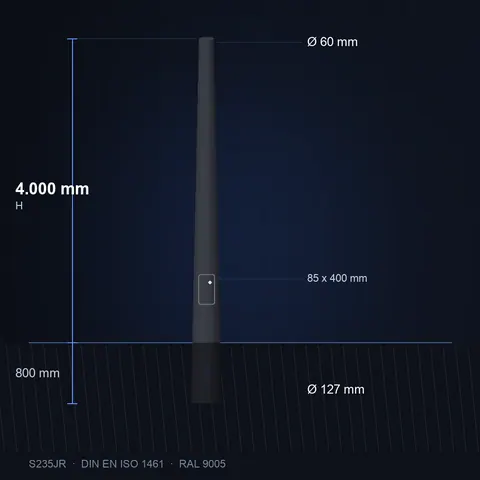 News
New: steel and aluminium lighting columns to the Dutch standard
Lichtplein now supplies conical steel lighting columns of 4 and 6 metres at a sharp price on request, plus aluminium columns of 3, 4 and 6 metres. With full dimensions on the product page, matching our street and post-top luminaires, delivered by truck.
8 October 2026 Knowledge
UFO or linear high bay: which one for your warehouse or hall
A high bay comes as a round UFO, as a linear luminaire above the racking aisle and as a flat panel with UGR<21. Which one you choose depends on mounting height, racking and the work done in the hall. This article gives the selection rules and a worked example for the number of luminaires.
8 October 2026