When is a solar lighting column the best choice
A solar lighting column needs no cable and no grid connection. We explain when that pays off, how the battery gets through the winter and which sites are suited to it.
In brief
A solar lighting column generates its own electricity by day with a solar panel, stores it in a battery and lights the site at night. No trench, no cable, no application to the network operator. That makes it attractive wherever mains power is absent or a cable is disproportionately expensive. In the Lichtplein range the solar lighting column sits in the CIVIS series, alongside the aluminium lighting columns and the CityCharger charging column. Price on request, sized per project.
- Choose solar where there is no mains supply, for long cable runs, temporary sites and locations where you need light quickly.
- Choose mains power for high lighting levels, long burning hours at full output and sites where the cable is already in the ground.
- Always: have the panel, battery and dimming profile sized for the darkest months, not for the annual average.
Where mains power is absent or too expensive
The question is rarely whether solar is technically possible, but what electricity costs at that spot. For a mains-fed column you pay not only for the column and the luminaire, but also for the trench, the underground cable, the ducting beneath paved areas, reinstatement of paving or planting, the NEXUS column cut-out and the connection itself. If the nearest supply is two hundred metres away on the other side of a road or ditch, the cable run soon costs more than the columns.
Then there is the grid connection. A new connection or an upgrade often takes the network operator months, and in areas with grid congestion it is sometimes not available for the time being. A solar lighting column is live as soon as the foundation has cured and the column is installed. For a construction site that opens next month, that is often the deciding factor.
Cable costs versus solar: how to compare
Put the two options side by side per lighting point over a period of fifteen to twenty years:
- Mains-fed: steel or aluminium column, luminaire, column cut-out, share of the cable run and the connection, plus electricity and standing charges every year.
- Solar: column with panel, battery and charge controller, luminaire, foundation, plus one battery replacement within the period. No electricity costs, no standing charge.
A rule of thumb from practice: the more metres of trench per lighting point, the sooner solar wins. For a row of columns along a cycle path outside the built-up area, with no supply nearby, the cable per column is the largest item. For a compact car park next to a building it is the other way round. If you want exact figures, we calculate both variants for you in a lighting design (350 euros excl. VAT) with a matching parts list.
Battery and autonomy in winter
Winter dictates the design. In December a solar panel in the Netherlands yields only a fraction of what it yields in June, while the night then lasts up to sixteen hours. A solar lighting column sized on the annual average will be dark in January. So you design for the worst month and for a run of dark, overcast days in a row.
Three settings decide whether that works:
- Panel output and orientation: the panel must be free of shade, facing south and at a steep angle, so that it also catches the low winter sun and sheds snow.
- Battery capacity and autonomy: three to five nights of autonomy without meaningful charging is common. Lithium iron phosphate batteries last thousands of charge cycles and tolerate deep discharge better than lead-acid batteries, but must be protected from frost, preferably in the base of the column or in the foundation where the temperature is more stable.
- Dimming profile: full output in the evening, down to 30 to 50 per cent in the small hours and back up on movement. That cuts night-time consumption considerably without users noticing.
A modern LED luminaire of 150 to 180 lm/W helps here: for a cycle path in lighting class P4 according to EN 13201 (average 5 lux, minimum 1 lux) a luminaire of 15 to 25 W on a column of 4 to 6 metres is often enough. For a car park in class P3 (average 7.5 lux) you allow a little more. Choose an optic that directs the light onto the path and limits glare and spill light. The lower the output, the smaller the panel and battery and the lower the price per column.
Remote monitoring
A column without a cable also has no fuse in the distribution board that you can quickly check, so monitoring is not a luxury with solar. The solar lighting column in the CIVIS series comes with remote monitoring. With a well set-up monitoring system you see per column the state of charge of the battery, the yield of the panel and any faults; exactly which data are available depends on the version and is agreed with you when you enquire. If a battery runs down during a dark week, you see it before the column goes out, and you lower the dimming profile temporarily instead of sending out an engineer. You plan battery replacement on measured capacity rather than calendar age, and you can demonstrate that the lighting was on.
Applications
- Car parks at sports parks, business parks and leisure sites, especially where the car park is detached from the building.
- Cycle paths and footpaths outside the built-up area, where there is no supply nearby and a cable run through farmland or nature is undesirable.
- Temporary sites: construction sites, event grounds, temporary car parks and emergency locations. After the job the column moves on to the next project.
- Bus stops, car-share sites and remote entrances, where one or two lighting points are needed and a connection does not pay.
When a mains-fed column is the better choice
If you need high lighting levels, such as on a loading yard or a sports pitch with floodlights from the FLUX or ARENA series, the power is too great for a panel on the column. Equally, where the lighting must burn at full output all night, in a narrow street shaded by trees or buildings, or where the cable is already in the ground, choose a mains-fed column. Then combine a steel TURRIS or aluminium CIVIS column with a VIA street luminaire or a POLARIS post-top luminaire.
With both variants, pay attention to the foundation. A panel on top of the column increases the wind area, so the column and foundation are calculated for it in accordance with EN 40. When you enquire, therefore, state the location, the required lighting class and the soil type.
Frequently asked questions
Does a solar lighting column stay on all night in winter?
Yes, provided it has been sized for the darkest month. That requires a sufficiently large panel, a battery with three to five nights of autonomy and a dimming profile that reduces consumption in the small hours.
How long does the battery last?
A lithium iron phosphate battery on a daily cycle usually lasts many years; the exact lifetime depends on depth of discharge and temperature. Allow for one replacement within the lifetime of the column and plan it on the capacity measured through the monitoring.
What height is a solar lighting column?
Project dependent, in practice usually 4 to 6 metres for cycle paths and car parks. The panel sits on top of the column, so the wind area and the foundation are calculated per location.
Can I move a solar lighting column later?
In principle, yes. Since there is no cable, you unbolt the column from its foundation and install it elsewhere on a new foundation or a movable concrete block. State in your enquiry that the column needs to be relocatable, so that the version and the foundation are chosen accordingly.
What does a solar lighting column cost?
Price on request. The price depends on column height, panel output, battery capacity and the luminaire, and is set per project. From 20 columns we offer a project price.
View the solar lighting column in the CIVIS series or request a quotation with the location and the required lighting level; we will calculate solar and mains-fed for you. Lichtplein supplies businesses only.
Read also
 Knowledge
LED lighting before year end: KIA, EIA and planning for Dutch businesses
Many companies replace their lighting in the last months of the year. What the Dutch small-scale investment allowance (KIA) and energy investment allowance (EIA) can mean, what to watch out for and how to have the luminaires on site in time.
28 October 2026 Knowledge
Site lighting for the dark months: checklist for business sites and car parks
Once the clocks go back it is dark by half past four, and the first and last hour of the working day happen in the dark. How to check your outdoor lighting now, fill the gaps and have the luminaires on site before the shortest days.
25 October 2026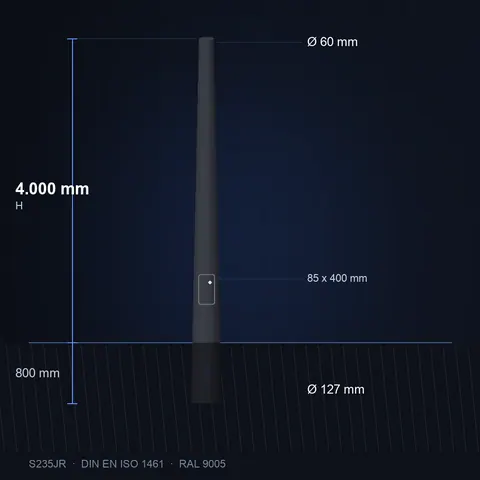 News
New: steel and aluminium lighting columns to the Dutch standard
Lichtplein now supplies conical steel lighting columns of 4 and 6 metres at a sharp price on request, plus aluminium columns of 3, 4 and 6 metres. With full dimensions on the product page, matching our street and post-top luminaires, delivered by truck.
8 October 2026 Knowledge
UFO or linear high bay: which one for your warehouse or hall
A high bay comes as a round UFO, as a linear luminaire above the racking aisle and as a flat panel with UGR<21. Which one you choose depends on mounting height, racking and the work done in the hall. This article gives the selection rules and a worked example for the number of luminaires.
8 October 2026